What Is PQ? Performance Qualification Meaning and Tests
Performance qualification (PQ) is the documented verification that equipment or a system performs effectively and reproducibly when it is used the way production will use it: with production materials or a proven equivalent, routine procedures, trained operators, and the loads and batch sizes production will actually use. It is the last equipment qualification stage. Installation qualification (IQ) proves the equipment was installed to specification, operational qualification (OQ) proves it operates across its specified ranges, and PQ proves it delivers acceptable results, consistently, in real use. A PQ runs the equipment more than once under those routine conditions, samples the output against acceptance criteria approved before testing starts, and shows that the results hold from run to run. When the PQ passes, you have the evidence that the equipment is ready for routine production or for process validation.
This article covers what that means in practice: what the regulations say, what a PQ tests, how many runs it needs, a worked example on a pouch sealer, how PQ differs from OQ and from process performance qualification (PPQ), what PQ looks like for common equipment, and the audit findings to avoid. If your question is whether a particular piece of equipment needs a PQ at all, start with when a PQ is not required.
What the regulations say PQ is
EU GMP Annex 15 (2015), which applies to medicinal products, defines performance qualification in its glossary as "the documented verification that systems and equipment can perform effectively and reproducibly based on the approved process method and product specification." Two words in that definition carry most of the weight. "Reproducibly" means one good run is not enough. "Approved process method" means the test is run the way the process will be run, not the way an engineer would run a demonstration.
Annex 15 then sets out what PQ should contain. Paragraph 3.13 says PQ should normally follow the successful completion of IQ and OQ, though it may in some cases be appropriate to perform it in conjunction with OQ or process validation. Paragraph 3.14 says PQ should include tests using production materials, qualified substitutes, or simulated product proven to have equivalent behavior, under normal operating conditions with worst case batch sizes, with a justified sampling frequency, and that the tests should cover the operating range of the intended process unless documented evidence from development already confirms the operational ranges.
The FDA's 2011 guidance, "Process Validation: General Principles and Practices," which covers drugs and biologics (not medical devices), does not use performance qualification as a stage name, and that causes real confusion. In that guidance, "PQ" is the abbreviation for process qualification, which is all of Stage 2. Stage 2 has two elements: design of the facility and qualification of the equipment and utilities, and process performance qualification (PPQ). What most companies call equipment PQ lives inside the first element. The guidance still describes it plainly: equipment qualification should include challenging the equipment or system functions while under load comparable to that expected during routine production, should include the interventions, stoppage, and start-up expected during routine production, and should show that operating ranges can be held as long as routine production needs them.
For medical device manufacturers, the underlying requirement is ISO 13485:2016 clause 7.5.6, which requires validation of production processes whose output cannot be, or is not, verified by subsequent monitoring or measurement. Since February 2, 2026, the FDA Quality Management System Regulation has incorporated ISO 13485:2016 by reference into 21 CFR Part 820, so that clause now anchors the US requirement. The GHTF process validation guidance for devices (SG3/N99-10:2004), which shaped the IQ, OQ, PQ convention in device manufacturing, frames PQ as establishing by objective evidence that the process, under anticipated conditions, consistently produces product that meets all predetermined requirements. In device practice, the PQ of a special process such as sealing or sterilization is often the process validation of that step.
Where PQ sits in the qualification sequence
Each qualification stage answers one question.
- Design qualification (DQ) asks whether the proposed design is suitable for its intended purpose. See the design qualification guide.
- Installation qualification (IQ) asks whether the equipment was delivered and installed to specification.
- Operational qualification (OQ) asks whether the equipment operates as intended across its specified ranges, including at the limits and under worst-case conditions. See what operational qualification is.
- Performance qualification (PQ) asks whether the equipment, used the way production will use it, consistently produces acceptable results.
- Process performance qualification (PPQ) asks whether the full commercial process consistently produces conforming product. See the PPQ protocol guide.
PQ is the bridge between the equipment and the process. OQ proved the window exists. PQ proves the equipment stays inside it when real material, real people, and real schedules are involved. For the full anatomy of the three core stages side by side, see IQ vs OQ vs PQ: what goes in each protocol.
What a PQ tests
A PQ is built from the process requirements and the risk assessment, and most PQs combine five elements.
Representative material and load. The equipment processes production materials, a qualified substitute, or simulated product proven to behave the same way. Load configurations, fill levels, and batch sizes match what production will use, including the worst case batch size Annex 15 asks for. A PQ on an empty chamber is an OQ with a different title.
Routine conditions. The PQ uses the settings production will use, the operating procedures released for routine or PQ use, and the operators who will run the equipment day to day. Where the process has a defined operating range rather than a single setpoint, Annex 15 expects the PQ to cover that range unless development data already confirms it. Outside Annex 15, the protocol states which settings the PQ uses and why.
Routine events. Production does not run in one clean, uninterrupted cycle, and the PQ should not either. Start-up, planned stops, restarts, changeovers, and the interventions operators make during normal running belong in the test, because those are where many failures begin. The FDA guidance names interventions, stoppage, and start-up directly.
Duration. The equipment holds its performance for as long as production will need it to: a full shift, a full batch, a full storage period. A ten-minute demonstration of a process that runs for eight hours proves very little about hour seven.
Repetition and sampling. The PQ repeats the run enough times to show reproducibility, and it samples the output at a justified frequency across each run, including at start-up and after interruptions. The sampling plan is part of the protocol, with its rationale, before the first run.
How many PQ runs do you need?
No regulation sets a number of runs for an equipment PQ. Three consecutive successful runs is a widely used convention, and it is often a sensible minimum, but it is a convention and the protocol has to justify whatever number it uses.
The closest regulatory anchor is in Annex 15's process validation section. Paragraph 5.19 says the number of batches should be based on quality risk management, allow the normal range of variation and trends to be established, and provide sufficient data for evaluation, and that each manufacturer must determine and justify the number. Paragraph 5.20 adds that a minimum of three consecutive batches under routine conditions is generally considered acceptable for process validation, with an alternative number allowed when justified. That logic transfers well to equipment PQ: pick a number that captures the variation that matters.
What drives the number up: several operators or shifts, more than one lot of incoming material, several load configurations, seasonal or ambient sensitivity, and limited history with the technology. What can bring it down: a well-understood standard technology, identical equipment already qualified at the site, and strong OQ data on the same settings. Record the reasoning in the protocol, not only the number.
A worked example: PQ on a pouch sealer
Consider the heated-jaw sealer from the PFMEA worked example, which closes a sterile barrier pouch for a medical device. For sterile barrier systems, ISO 11607-2 requires the forming, sealing, and assembly processes to be validated, and sealing is a textbook special process: seal strength can only be tested by destroying the seal, so inspection alone cannot confirm every pouch. ISO 13485:2016 clause 7.5.7 adds particular requirements for validating sterile barrier system processes. IQ has confirmed the sealer and its instruments. OQ has established the validated window for jaw temperature, dwell time, and pressure, challenged at low, nominal, and high settings. It also challenged the controls the PFMEA called for: the temperature interlock, the redundant thermocouple, and the seal-width vision check. The setting choices are covered in how to set OQ machine parameters.
Because this is a device packaging process, outside Annex 15's scope, and the OQ already challenged the limits of that window, the protocol justifies running the PQ at the routine settings. It asks whether the sealer, run as production will run it, makes good seals every time:
- Settings and materials. Three runs at the routine production settings, each using production pouch stock, with at least two lots of pouch material across the runs so lot-to-lot variation is in the data. The protocol justifies three: one sealer, one pouch configuration, two lots and two shifts covered, and OQ data already in hand at the same settings.
- People and procedures. Production operators run the sealer under the operating procedure released for PQ use, across more than one shift.
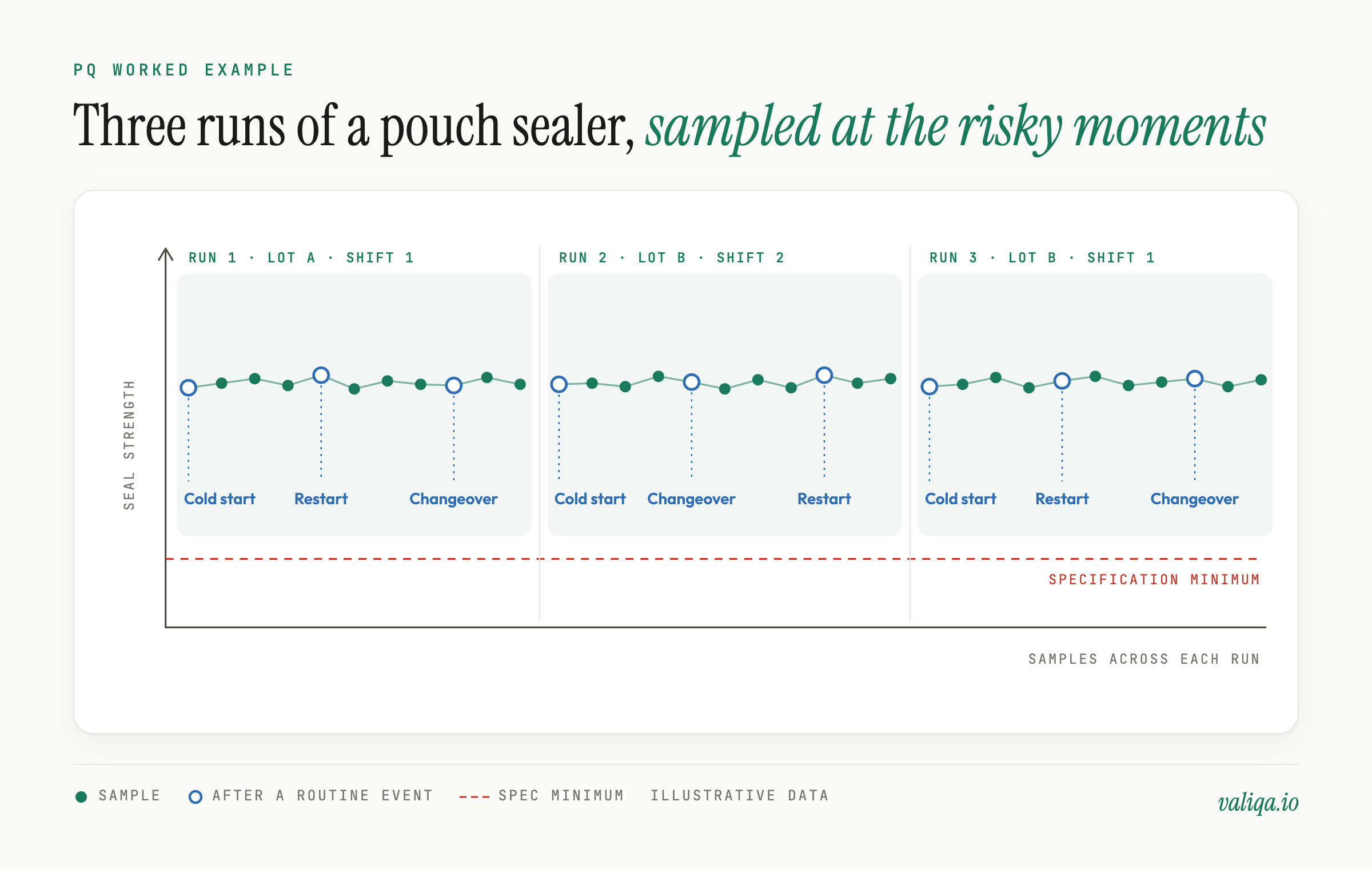
- Duration and routine events. Each run lasts a full production run length and includes a cold start-up, a planned stop and restart, and a pouch-stock changeover.
- Sampling. Pouches are pulled at start-up, at fixed intervals through the run, and immediately after each restart and changeover, following the sampling plan in the protocol.
- Tests and criteria. Sampled pouches are tested for seal strength by peel test (ASTM F88 is the common method) against the minimum from the packaging specification, for seal integrity by dye penetration (for example ASTM F1929) with zero channels allowed, and visually for seal continuity and defects (for example ASTM F1886). Every sample must meet every criterion, and the run-to-run results are evaluated for trends by the method and limits the protocol defines in advance.
Notice what the PQ adds. The OQ already showed the sealer can make a good seal at the edges of its window. Only the PQ shows that the first seals after a cold start are as strong as the seals that follow, that a new lot of pouch stock does not change the result, and that two different operators get the same outcome. Those are the conditions under which real seals fail.
PQ vs OQ
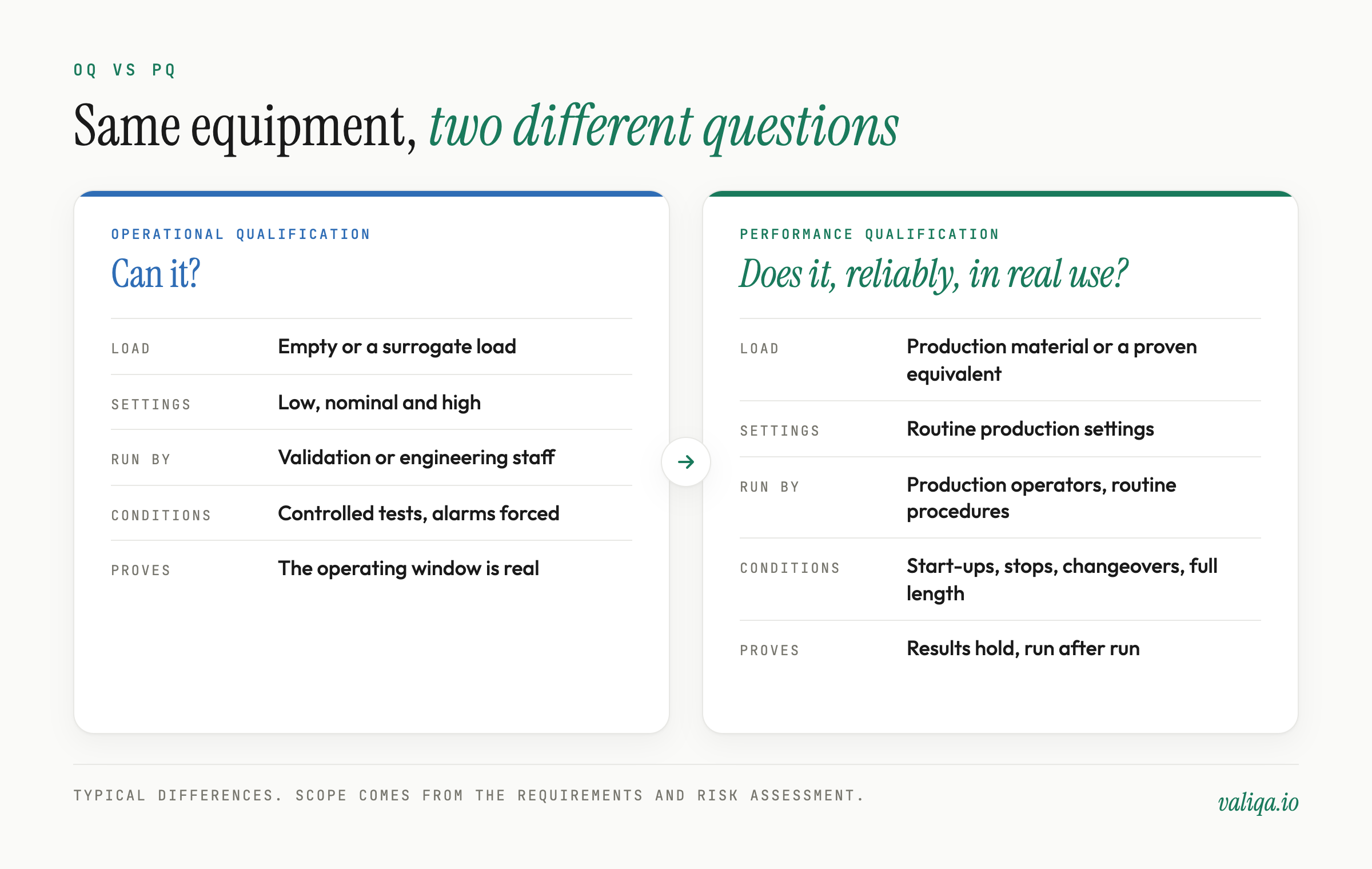
OQ tests capability. PQ tests performance in use. An OQ typically runs the equipment empty or with a surrogate load, drives each critical parameter to its low, nominal, and high points, forces alarms and interlocks, and is usually executed by engineering or validation staff under controlled test conditions. A PQ runs the equipment with real or proven-equivalent material, at routine settings, under routine procedures, operated by the people who will run it in production, repeatedly and for the full duration of real use.
The quickest way to tell them apart: OQ answers "can it?" and PQ answers "does it, reliably, in real use?" A temperature chamber that holds its band empty in OQ can still fail PQ when it is loaded densely and the door opens every twenty minutes. The OQ explainer has the matching worked example on the OQ side.
Annex 15 allows PQ to be performed in conjunction with OQ in some cases. The trade-offs of a combined protocol, and the hold points it needs, are covered in combined vs separate OQ/PQ protocols.
PQ vs PPQ
The names are close and the scope is different. Equipment PQ qualifies one piece of equipment or one system under routine conditions. Process performance qualification, in the FDA lifecycle model, qualifies the whole commercial manufacturing process: qualified equipment, qualified utilities, trained staff, approved materials, and the control strategy, together, producing commercial batches. Equipment PQ does not replace PPQ: a company can have every machine on a line through PQ and still need PPQ batches before commercial distribution. PPQ does not replace IQ and OQ either, but where a justified plan performs the equipment PQ in conjunction with process validation, as Annex 15 paragraph 3.13 allows, the PPQ runs carry that evidence and the validation plan says so. Device manufacturers who follow the GHTF model often use PQ for the process-level demonstration too, which is closer to PPQ than to equipment PQ, so check which sense a document means. The PPQ protocol guide covers batch numbers and protocol structure for PPQ.
What PQ looks like for common equipment
The five elements stay the same. What changes is what "used the way production will use it" means for each kind of equipment.
| Equipment | What the PQ typically demonstrates |
|---|---|
| Heat sealer for sterile barrier pouches | Repeated runs at routine settings with production pouch stock, sampled for seal strength, seal integrity, and visual defects, including after start-up and restarts |
| Steam sterilizer (autoclave) | Each defined load pattern sterilized at the routine cycle, with temperature sensors in the load and biological indicators where the sterilization standard calls for them, repeated to show reproducibility |
| Cold room, freezer, or stability chamber | Temperature distribution with a representative load under routine use, including door openings, over a period long enough to be meaningful; see the temperature mapping guide and does a -80C freezer need a PQ |
| Purified water system | Sampling at every point of use over an extended, phased program, commonly with a final phase long enough to capture seasonal variation |
| Tablet press or filling line | Runs with product at routine speed for full batch lengths, sampling weight or fill volume and other quality attributes across the run, including start-up and stoppages |
Treat this as a starting point for scoping, not a checklist. The protocol for each system still comes from its requirements and its risk assessment.
When PQ is not needed
Not every piece of equipment needs a PQ. The three legitimate cases are output that is fully verified on every unit downstream, equipment with no direct impact on product quality established by a documented risk assessment, and performance evidence that already exists in another document such as a combined OQ/PQ or a process-level qualification. Each case has conditions, and each needs a written rationale. The full decision, with examples, is in when is a PQ not required, and the wider scoping question is in does equipment need IQ only or full IQ/OQ/PQ.
When a PQ run fails
A failed PQ run is a deviation, not a rerun. The actual results are recorded exactly as observed, the failure is documented and investigated under your deviation procedure, and the investigation establishes a cause before anyone decides what happens next. Annex 15 paragraph 2.8 expects results that fail pre-defined acceptance criteria to be recorded as deviations and fully investigated.
The cause decides the path. An equipment fault is corrected, and the run count usually restarts when the protocol requires consecutive successful runs. A sampling or test method error may justify repeating the affected test with a recorded rationale. A failure caused by a routine event, such as poor seals after a restart, is a finding about the process, and the fix (a warm-up procedure, a changed restart step) has to be proven by the PQ itself, not assumed. A criterion that was genuinely wrong is changed only through a documented, scientifically justified protocol change, never by editing the number to fit the data. The final report lists every deviation, its cause, its resolution, and its impact on the conclusion.
What a PQ protocol contains
Headings vary by company procedure, but a complete PQ protocol carries these sections:
- Approval page. Author, reviewers, and approvers, including quality, signed before execution.
- Purpose and scope. The equipment or system, its identifier and location, the process or product it serves, and what the protocol covers and excludes.
- References. User requirements, the risk assessment, the approved IQ and OQ reports, the validation master plan, operating procedures, and product or packaging specifications.
- Prerequisites. IQ and OQ approved, or any open items covered by a documented assessment showing no significant impact on the PQ, instruments calibrated, operating procedures finalized after OQ or released for PQ use, and operators trained on them.
- Test strategy. Number of runs and the justification, materials and lots, load configurations, settings, duration, and the routine events each run will include.
- Sampling plan. What is sampled, when, how many, and why that frequency is adequate.
- Test cases and acceptance criteria. For each test: method, expected result with its source, space for the recorded result, pass or fail, and executor signature and date. The acceptance criteria guide covers how to write criteria that hold up.
- Deviation handling. How failures and departures from the protocol are recorded and resolved.
- Traceability. Links from requirements and risks to PQ tests, often within a wider traceability matrix.
- Summary report. Results for every run, deviations and their closure, the conclusion, and release to routine use or to process validation.
Common PQ audit findings
These are common weaknesses in PQ packages.
- An OQ relabeled as PQ. Empty-chamber or surrogate runs at engineering settings, executed by the validation team, presented as performance qualification.
- One run. A single successful run offered as evidence of reproducibility.
- No justification for the number of runs. Three runs, with no explanation of why three captures the variation that matters.
- Routine events left out. No start-up, restart, changeover, or intervention in any run, so the conditions where failures begin were never tested.
- Unrepresentative material or load. One lot of material for every run, a lighter load than production uses, or a batch size smaller than the worst case.
- Sampling without a rationale. Samples taken only at the end of a run, or at a frequency nobody can justify.
- Criteria with no source. Limits that do not trace to a product, packaging, or process specification.
- Failed runs quietly repeated. A failed run replaced by a new one without a deviation, investigation, or restart of the run count.
- Production running outside what PQ covered. Settings, loads, or materials in routine use that the PQ never included.
How Valiqa fits
Valiqa generates PQ protocols from equipment specifications, alongside the IQ and OQ, with acceptance criteria and regulatory mappings drafted for review and approval by your team. Approvals use Part 11 electronic signatures, changes and signatures are recorded in a hash-chained audit trail, and execution runs as guided step-by-step testing, so results are recorded against the approved expected results at the time each step is performed and failures go straight into deviations.
The short version
Performance qualification is where equipment proves it works in real use, not only on test day. Run it with real material, routine settings, routine people, and routine interruptions, for the full length of real use, more than once. Justify the number of runs and the sampling, write criteria that trace to a specification, and treat every failed run as a deviation with a cause. That is a PQ that holds up.
---
Valiqa is an AI-powered validation lifecycle platform for regulated manufacturing. Learn more at valiqa.io
Get new validation guides in your inbox
One or two practical guides a week, written for validation engineers. Unsubscribe anytime. Privacy policy
Frequently Asked Questions
Generate IQ, OQ, and PQ protocols in minutes
Enter your equipment details and Valiqa drafts test steps, acceptance criteria, and traceability to your requirements. You review and edit each document, then approve it with electronic signatures.
Start your 14-day free trialNo credit card required.
We use essential cookies for authentication and security. With your consent, we also use Microsoft Clarity, Google Analytics, and the LinkedIn Insight Tag on our marketing pages to understand how visitors navigate the site and to measure our advertising. Read our privacy policy.