When Is a PQ Not Required?

A performance qualification is not required in three situations: when every quality attribute the process produces is fully verified by subsequent monitoring or measurement, and that verification is actually performed on every unit; when the equipment has no direct impact on product quality, established through a documented risk assessment; or when the performance demonstration already exists in another document, such as a combined OQ/PQ protocol, a process-level performance qualification that exercises the equipment under commercial conditions, or a mapping study for monitored storage. Everything else needs a PQ. The regulatory basis is the verification test in ISO 13485:2016 clause 7.5.6, which the FDA Quality Management System Regulation incorporated by reference when it took effect on February 2, 2026, and which the older 21 CFR 820.75(a) expressed as the same test: processes must be validated where the resulting output cannot be fully verified afterward.
That is the short answer, and each branch of it has conditions attached. Getting this decision right matters in both directions. A PQ that was never needed burns weeks of protocol writing, execution, and review on evidence nobody required. A PQ that was needed and skipped is one of the easiest findings an auditor will ever write, because the gap is visible from the equipment list alone. This article walks through the regulatory test, the three legitimate exemption cases, the processes that look exempt but are not, and the documentation that makes a "no PQ" decision defensible.
What a PQ proves that IQ and OQ do not
The three qualification stages answer three different questions. Installation qualification proves the equipment arrived and was installed to specification. Operational qualification proves it performs within its specified ranges, usually challenged at the limits. Performance qualification proves the equipment or process produces conforming output consistently under real production conditions: actual product or a justified surrogate, trained operators, routine procedures, and normal batch-to-batch variation. The IQ, OQ, and PQ breakdown covers the full anatomy of each stage.
That definition already hints at when a PQ is dispensable. PQ exists to give you confidence in output you will not otherwise check. If every unit of output is going to be checked anyway, or the equipment cannot affect the output, or the same demonstration is already being run under a different heading, the PQ adds paper without adding confidence. The regulations are more precise about the first of those, so start there.
The regulatory test: can you fully verify the output?
ISO 13485:2016 clause 7.5.6 requires organizations to validate any production process "where the resulting output cannot be or is not verified by subsequent monitoring or measurement," with the consequence that deficiencies only become apparent after the product is in use. The "or is not" matters: even verifiable output triggers validation if you do not actually perform the verification. Since February 2, 2026, that clause is US law for medical devices through the QMSR, which restructured 21 CFR Part 820 to incorporate ISO 13485:2016 by reference. Teams with documentation predating the transition will know the same test from 21 CFR 820.75(a), which expressed the same requirement. The logic is symmetrical: full verification of process output makes process validation unnecessary, and the inability or the choice not to fully verify makes validation mandatory.
The GHTF process validation guidance (SG3/N99-10, the document that codified the IQ/OQ/PQ convention for devices) turns this into a decision tree. Is the process output fully verifiable by subsequent inspection and test? If yes, and verification is sufficient and cost-effective, verify the output and control the process appropriately. If no, or if verification alone is not economical or practical, validate the process. That decision tree is the single most useful tool for scoping PQ, because it forces the question attribute by attribute rather than machine by machine.
Pharmaceutical manufacturing frames the same decision through risk. EU GMP Annex 15 makes the scope and extent of qualification a justified, documented risk assessment of the facilities, equipment, utilities, and processes involved, under quality risk management principles. The FDA's 2011 process validation guidance places the commercial-scale demonstration at the process level, as process performance qualification, sitting on top of equipment qualification rather than duplicating it. In both traditions the conclusion is the same: PQ scope is a risk-based, documented decision, not a default that applies to every asset with a power cord.
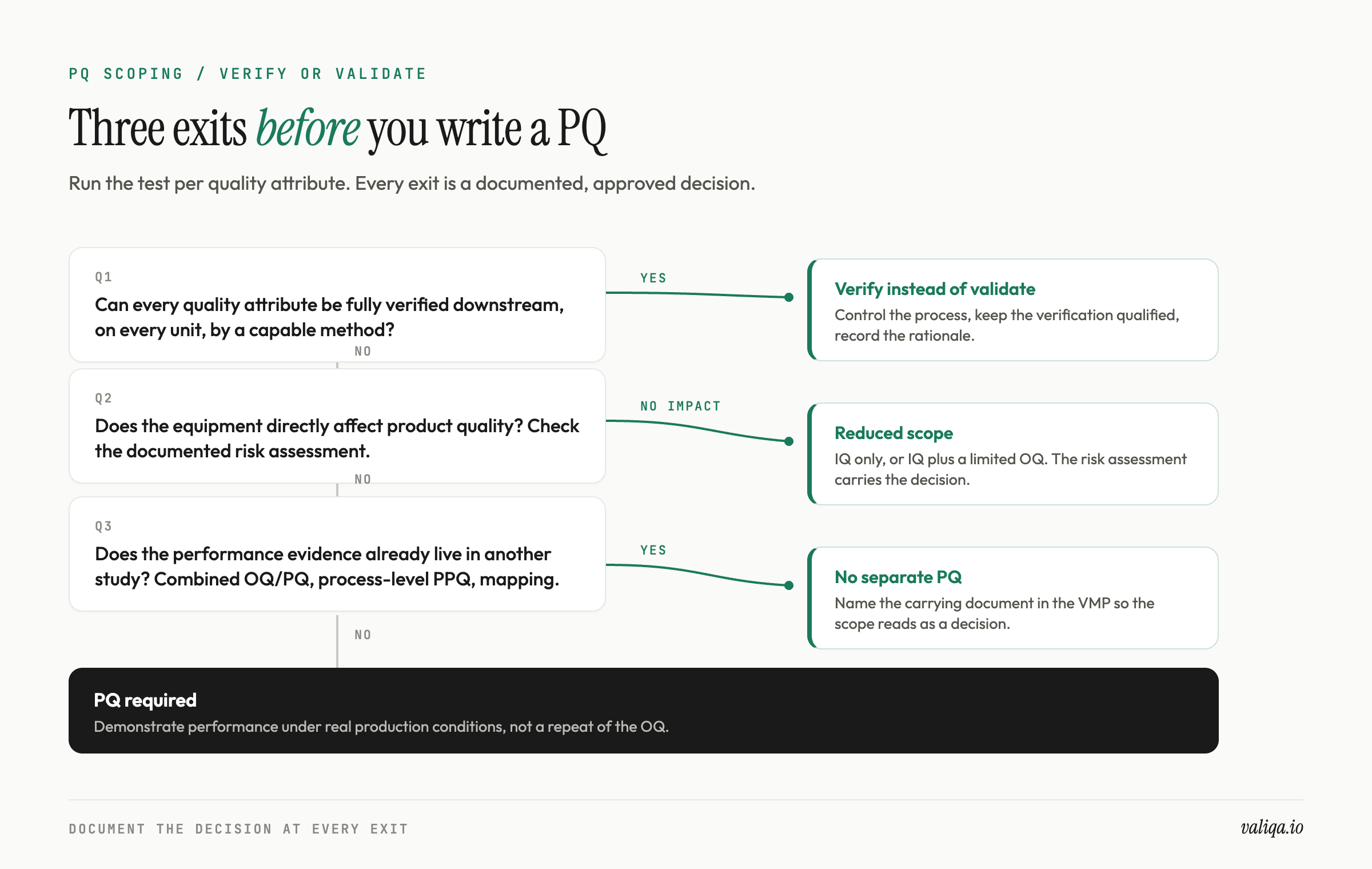
Case 1: the output is fully verified downstream
This is the strongest and most cited exemption, and it has the most conditions attached. A PQ is not required when subsequent verification catches every deficiency the process could produce. For that sentence to hold, all of the following must be true.
The verification must cover every quality attribute the process influences, not just the convenient ones. A machined component whose critical dimensions are all gauged after machining is verifiable. If the process also affects a surface property or a material condition that the gauging never touches, the output is only partially verified and the exemption collapses for the unverified attributes.
The verification must be applied to every unit, or the sampling basis must itself be justified as sufficient for the risk. One hundred percent dimensional inspection is full verification. A skip-lot sample of a cosmetic attribute may be acceptable control for that attribute's risk, but it is not the full verification that lets you skip validating a process whose failures are critical.
The verification method must be capable and, where it is itself a system, qualified. An automated vision system that inspects every label is only as good as the qualification behind it. There is a small irony here that auditors enjoy: teams sometimes replace a PQ with automated inspection, and the inspection system then needs its own qualification, including software validation under GAMP 5 categories if it is software-driven. The verification burden does not vanish. It moves.
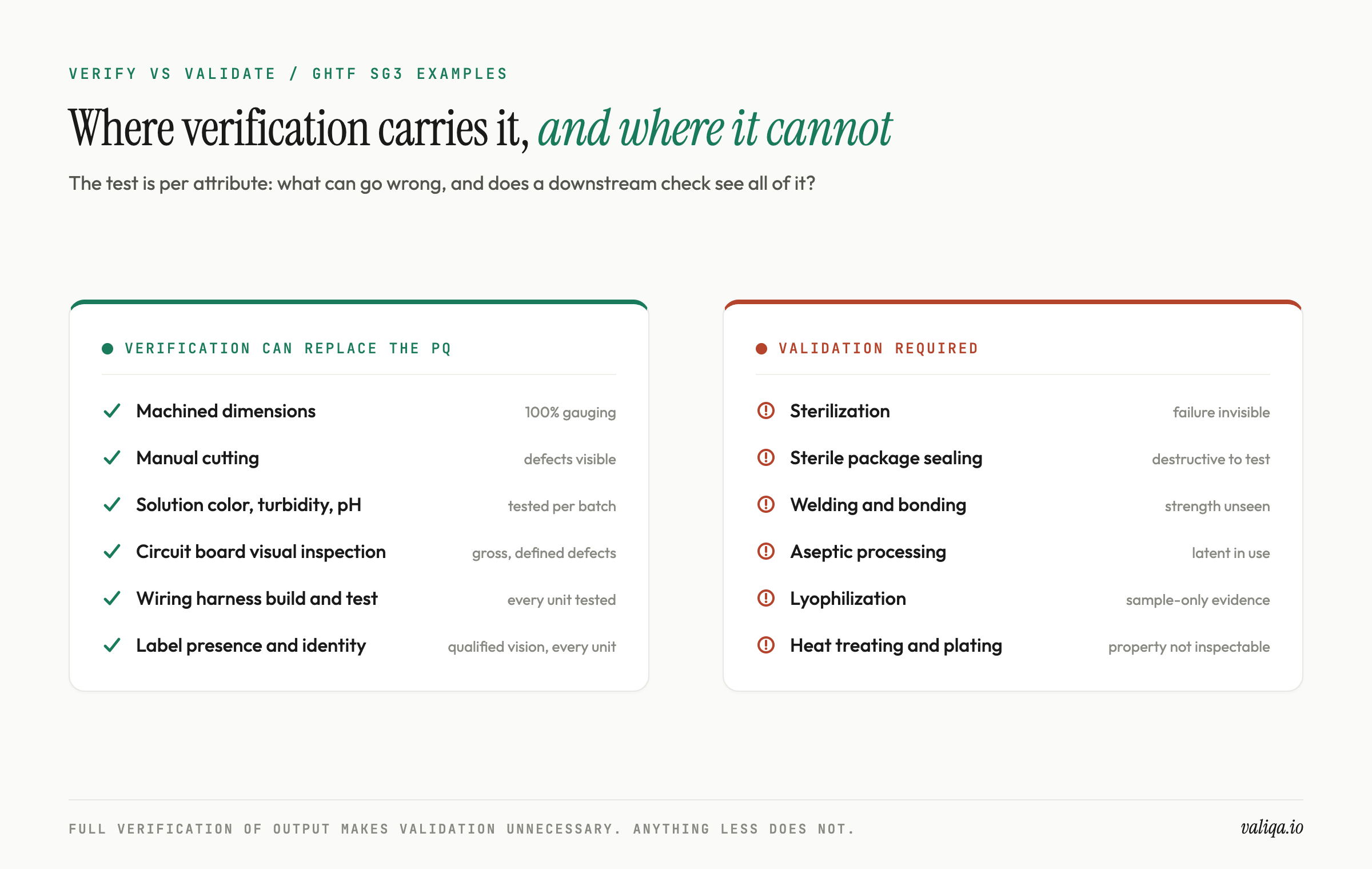
The GHTF guidance gives concrete examples of processes whose output verification can reasonably carry: manual cutting operations, testing solutions for color, turbidity, or pH, visual inspection of printed circuit boards, and the manufacture and test of wiring harnesses. The shared property is that the things that can go wrong are all visible to the downstream check.
Case 2: the equipment does not directly affect product quality
The second exemption is about impact, not verifiability. Equipment that cannot influence a product quality attribute has nothing for a PQ to demonstrate. Ancillary equipment is the usual population here: a parts washer for non-product-contact tooling, a conveyor that only moves sealed cartons between rooms, a chiller that serves a system which has its own qualified controls and alarms.
The instrument for making this call is a documented impact or risk assessment, and the scope decision it produces usually lands on IQ only, or IQ plus a limited OQ, rather than the full ladder. The dividing lines between those scopes, and the classification factors that drive them, are covered in detail in how to determine if equipment needs IQ only or full IQ/OQ/PQ. The short version for PQ specifically: if the risk assessment concludes the equipment has no direct product quality impact, the PQ question answers itself, but the assessment has to exist on paper, name the attributes it considered, and carry an approval. An unwritten judgment call is not a scoping decision. It is a gap with a delay on it. The same discipline covers the adjacent edge case of temporary and rental equipment, where the scoping question is the IQ rather than the PQ.
Be honest about indirect impact. Equipment that does not touch product can still affect it: a compressed air system feeding a product-contact process, an HVAC system holding a classified room, a controlled storage area holding temperature-sensitive material. Those systems carry quality impact through the parameter they deliver, and they are qualified for it, even if the documentary form differs from a classic three-run PQ.
Case 3: the performance evidence lives in another document
The third case is the one that generates the most confusion, because the work is being done and only the heading differs.
Combined OQ/PQ is explicitly recognized practice. Annex 15 states that PQ should normally follow the successful completion of IQ and OQ, but that it may in some cases be appropriate to perform it in conjunction with OQ or process validation. For simpler equipment, a single protocol that challenges operating ranges and then demonstrates performance under routine conditions is leaner than two documents with a signature cycle between them, and loses nothing evidentially. What matters is that the performance demonstration under normal production conditions actually appears in the combined protocol, not that a document titled "PQ" exists.
Process-level PPQ can carry the equipment-level demonstration. In the pharmaceutical lifecycle model, the process performance qualification runs the full commercial process on qualified equipment. Where a piece of equipment's real-use performance is exercised entirely within the PPQ runs, a separate equipment PQ that would rehearse the same conditions with the same product adds duplication, and many validation master plans scope it out deliberately. The scoping rationale belongs in the validation master plan so the strategy reads as a decision rather than an oversight.
Monitored storage is qualified through mapping. For cold rooms, warehouses, refrigerators, and freezers, the performance question is thermal: does every location hold the labeled condition under real loading, door traffic, and seasonal extremes? That evidence comes from a temperature mapping study, followed by continuous monitoring at the worst-case locations the map identified. Functionally that is the PQ. A team that runs a mapping study and then wonders whether it also needs a document called "PQ" for the same room is usually holding the answer already.
Analytical instruments follow their own model. For laboratory instruments, USP General Chapter 1058 on analytical instrument qualification keeps the PQ concept but changes its shape: performance qualification there is the ongoing demonstration that the instrument remains fit for use, through periodic checks and system suitability testing, rather than a one-time production-style protocol. The label is the same and the evidence is different, which is exactly why scoping decisions should name the evidence, not just the acronym. Storage equipment reads the same way: for a -80C freezer, the PQ takes the form of a loaded mapping study rather than a production-style protocol.
The processes that look verifiable but are not
The exemptions above have a gravitational pull, and some processes get dragged into them that do not belong. The GHTF guidance is blunt about the canonical examples: sterilization, aseptic filling, sterile package sealing, lyophilization, heat treating, plating, and injection molding are processes whose deficiencies are not reliably visible in downstream inspection. You cannot test sterility into a batch, and a seal-strength test destroys the seal it measures. These processes are validated because verification is either impossible, destructive, or statistical by nature.
The subtler traps are worth naming.
Destructive tests are not full verification. If proving the attribute consumes the unit, you can only ever test a sample, and a sample tells you about the process, which is precisely what validation formalizes. Seal integrity, weld strength, and bond strength live here.
Latent failures defeat inspection. A cosmetic check on a solder joint does not verify its fatigue life. Where the failure mode develops in use, the clause 7.5.6 language about deficiencies becoming apparent "only after the product is in use" applies literally, and the process needs validation regardless of how good the inspection looks.
Human inspection has limits. Manual visual inspection is a legitimate verification method for gross, well-defined defects, but claiming it as one hundred percent verification of a subtle attribute invites the obvious challenge. If the defect requires magnification, judgment, or vigilance over thousands of units, the risk assessment should treat the inspection as a control with a known escape rate, not as full verification.
A useful discipline is to run the verification question per attribute, in writing, using the same process risk analysis a PFMEA provides. Each row names an attribute, the downstream check that would catch a failure, and whether that check is truly complete. Processes rarely fail the verification test wholesale. They fail it one attribute at a time, and the PQ scope follows the failed rows.
What to document when the answer is "no PQ"
Skipping a PQ is a validation decision, and validation decisions exist on paper or not at all. The documentation that makes the decision defensible is short and specific.
State the decision where scope is defined. The validation master plan or the equipment's qualification plan should say which qualification stages apply to the asset and why. A one-line scope table entry is enough when it points at the rationale.
Record the rationale with the evidence behind it. For a verification-based exemption, cite the inspection or test that provides full coverage, the attributes it covers, and the qualification status of the verification method itself. For an impact-based exemption, reference the risk assessment. For evidence-that-lives-elsewhere, name the document that carries the demonstration: the combined OQ/PQ, the PPQ protocol, the mapping study.
Get it approved. The same review and approval that a protocol would receive should sit on the scoping decision, including the quality function. An approved rationale converts "they never did a PQ" into "they decided a PQ was not required, and here is why," which are entirely different sentences in an audit room. What auditors actually look for is the reasoning chain, and a documented scope decision is a link in it.
Revisit it on change. The exemption is only as durable as its premises. If the hundred percent inspection is later reduced to sampling, if the process gains a new critical attribute, if the ancillary equipment is repurposed into product contact, the original rationale no longer holds and the question reopens. This is the same change-driven logic that governs when qualified equipment needs revalidation, applied to a decision instead of a protocol.
A worked pair makes the contrast concrete. A label applicator followed by a qualified vision system that verifies presence, identity, and placement of every label can defensibly run without a standalone PQ: every attribute the process affects is checked on every unit by a qualified method, and the rationale says exactly that. An induction sealer on the same line cannot make that argument. Seal quality is tested destructively on samples, failures can be latent, and no downstream check sees every seal. The sealer gets a PQ. Same line, same logic, opposite answers, and both of them written down.
The decision is the deliverable
"When is a PQ not required" sounds like a question about doing less work, and sometimes it is. But the real output of the analysis is not the skipped protocol. It is a documented, attribute-level argument about where your confidence in the product comes from: verification, validation, or evidence carried in another study. Plants that can produce that argument on request tend to have lean qualification programs and quiet audits. Plants that cannot produce it tend to have either too much paper or too little, and no way to say which.
Run the test per attribute. Claim the exemption only when its conditions genuinely hold. Put the rationale where an auditor can find it. And when the answer is that a PQ is required, write one that demonstrates performance under real conditions rather than repeating the OQ with a different title.
---
Valiqa is an AI-powered validation lifecycle platform for regulated manufacturing. Learn more at valiqa.io
Get new validation guides in your inbox
One or two practical guides a week, written for validation engineers. Unsubscribe anytime. Privacy policy
Frequently Asked Questions
Ready to automate your validation documentation?
Generate audit-ready IQ/OQ/PQ protocols in minutes, not weeks.
Get StartedWe use essential cookies for authentication and security. With your consent, we also use Microsoft Clarity, Google Analytics, and the LinkedIn Insight Tag on our marketing pages to understand how visitors navigate the site and to measure our advertising. Read our privacy policy.