Combined vs Separate OQ/PQ Protocols: How to Decide

Combine OQ and PQ into a single protocol when the equipment is simple or low risk, when the performance demonstration can run immediately after the operating-range challenges with the same team and the same materials, and when nothing depends on closing OQ before PQ data exists. Keep the protocols separate when the equipment is complex or high risk, when PQ needs actual product, production operators, or runs scheduled weeks after OQ finishes, when different owners approve the two phases, or when the site needs a closed OQ to release the equipment for engineering or ramp-up activities. Regulators accept both structures. EU GMP Annex 15 states that PQ should normally follow the successful completion of IQ and OQ, but that it may in some cases be appropriate to perform it in conjunction with OQ or process validation. Neither ISO 13485:2016 nor the FDA Quality Management System Regulation prescribes a document count. What they require is that the qualification evidence exists, is approved, and is traceable, whichever binder it lives in.
The structural decision looks minor next to the technical content, but it shapes the schedule, the approval flow, and how cleanly the record reads years later in an audit. This article covers what each structure actually looks like on paper, what the regulations say, the specific conditions that favor each choice, the traps that make combined protocols go wrong, and how to document the decision so it reads as a strategy rather than an accident.
What combined and separate actually look like
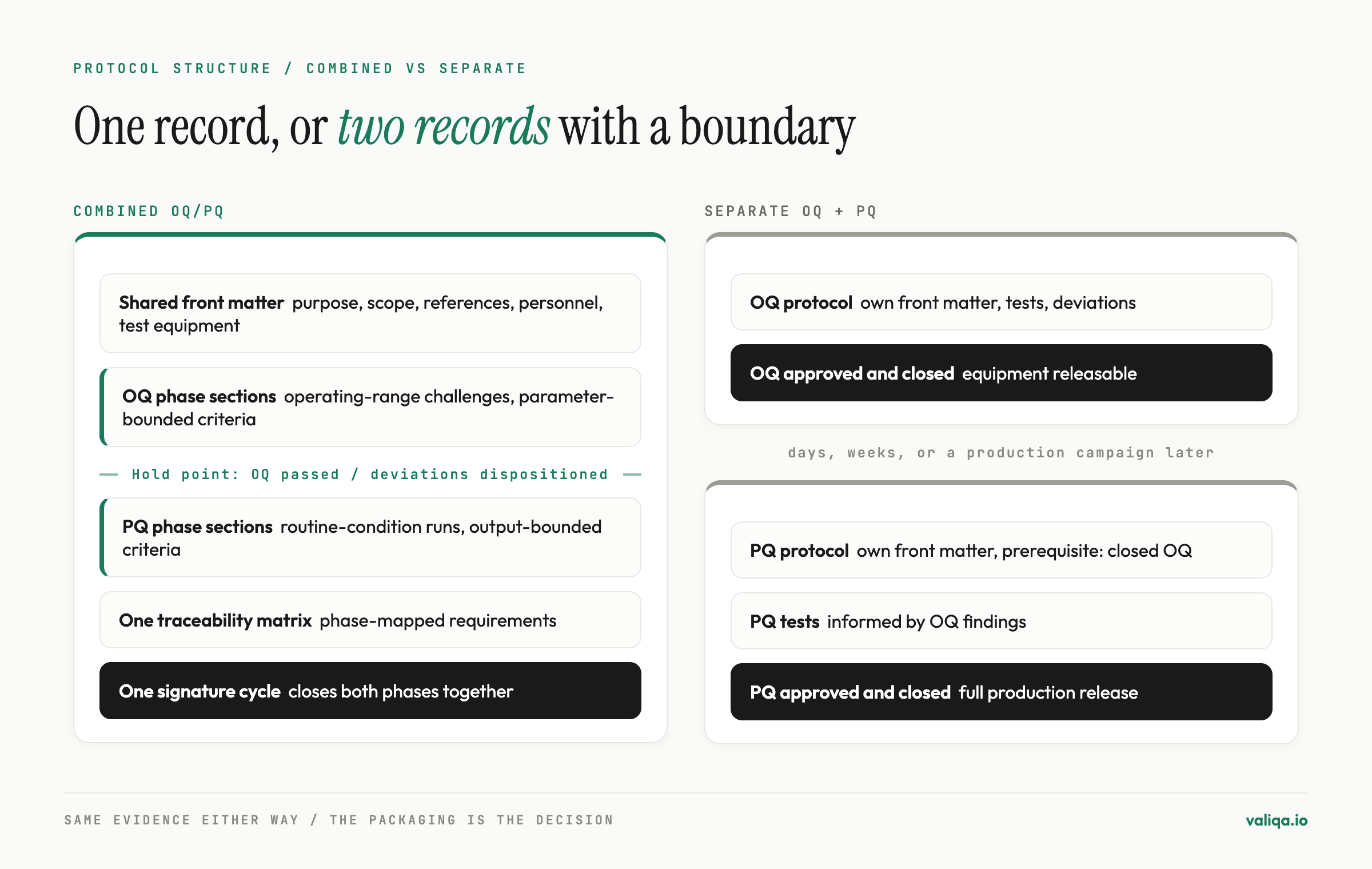
A separate structure produces two documents with their own lifecycle. The OQ protocol carries its own purpose, scope, references, test equipment list, test sections, acceptance criteria, deviation handling, and signature block. It is executed, its deviations are closed, a summary is written, and it is approved. The PQ protocol then does the same, usually referencing the closed OQ as a prerequisite in its own scope section. Each document stands alone: an auditor can pull the PQ and find everything needed to judge it, including the statement that OQ completed successfully first.
A combined structure produces one document with phase-grouped content. The front matter appears once: one purpose, one scope, one reference list, one personnel roster, one test equipment section. The test sections are then organized by qualification phase, with the OQ sections challenging operating ranges and the PQ sections demonstrating performance under routine conditions. One traceability matrix maps requirements across both phases, one exception report collects deviations, and one signature block closes the whole document. Execution normally proceeds phase by phase, with a hold point between phases: PQ steps do not start until the OQ steps have passed or their deviations have been dispositioned.
The combined format extends naturally downward as well. Combined IQ/OQ documents are common for straightforward installations, and a full combined IQ/OQ/PQ is a recognized format for equipment where all three phases run as one continuous campaign. The IQ, OQ, and PQ breakdown covers what belongs in each phase regardless of how the phases are packaged.
What the regulations actually say
No major regulation mandates one document per qualification phase. The phase structure is a convention, codified for medical devices by the GHTF process validation guidance (SG3/N99-10) and, for pharmaceuticals, by EU GMP Annex 15. The FDA's 2011 process validation guidance takes a lifecycle view, folding equipment qualification into Stage 2 alongside process performance qualification. All three define what must be demonstrated. None of them counts documents. Annex 15 goes further: clause 2.5 states that qualification documents may be combined together where appropriate, naming IQ and OQ as the example.
Annex 15 is the most explicit about sequencing and combination. It expects PQ to follow successful IQ and OQ, and it allows PQ to be performed in conjunction with OQ or with process validation in appropriate cases. The conditional matters: combination is an option to be justified, not a default. Annex 15 also expects the overall qualification strategy, including choices like this one, to be defined in a validation master plan or equivalent planning document.
For devices, ISO 13485:2016 clause 7.5.6 requires validation of processes whose output cannot be, or is not, verified by subsequent monitoring or measurement, and the FDA Quality Management System Regulation, in effect since February 2, 2026, incorporates ISO 13485:2016 into 21 CFR Part 820 by reference. Teams with documentation predating the transition will know the same requirement from 21 CFR 820.75. None of these texts count documents. An auditor working from any of them is checking that installation, operating ranges, and performance under routine conditions were each demonstrated, approved, and are traceable to requirements. A combined protocol that does all three is compliant. Separate protocols that do all three are compliant. A document of either shape that skips the performance demonstration is not, a failure mode covered in detail in when a PQ is not required.
When a combined OQ/PQ protocol wins
The combined format earns its keep when the two phases genuinely run as one campaign. The specific conditions:
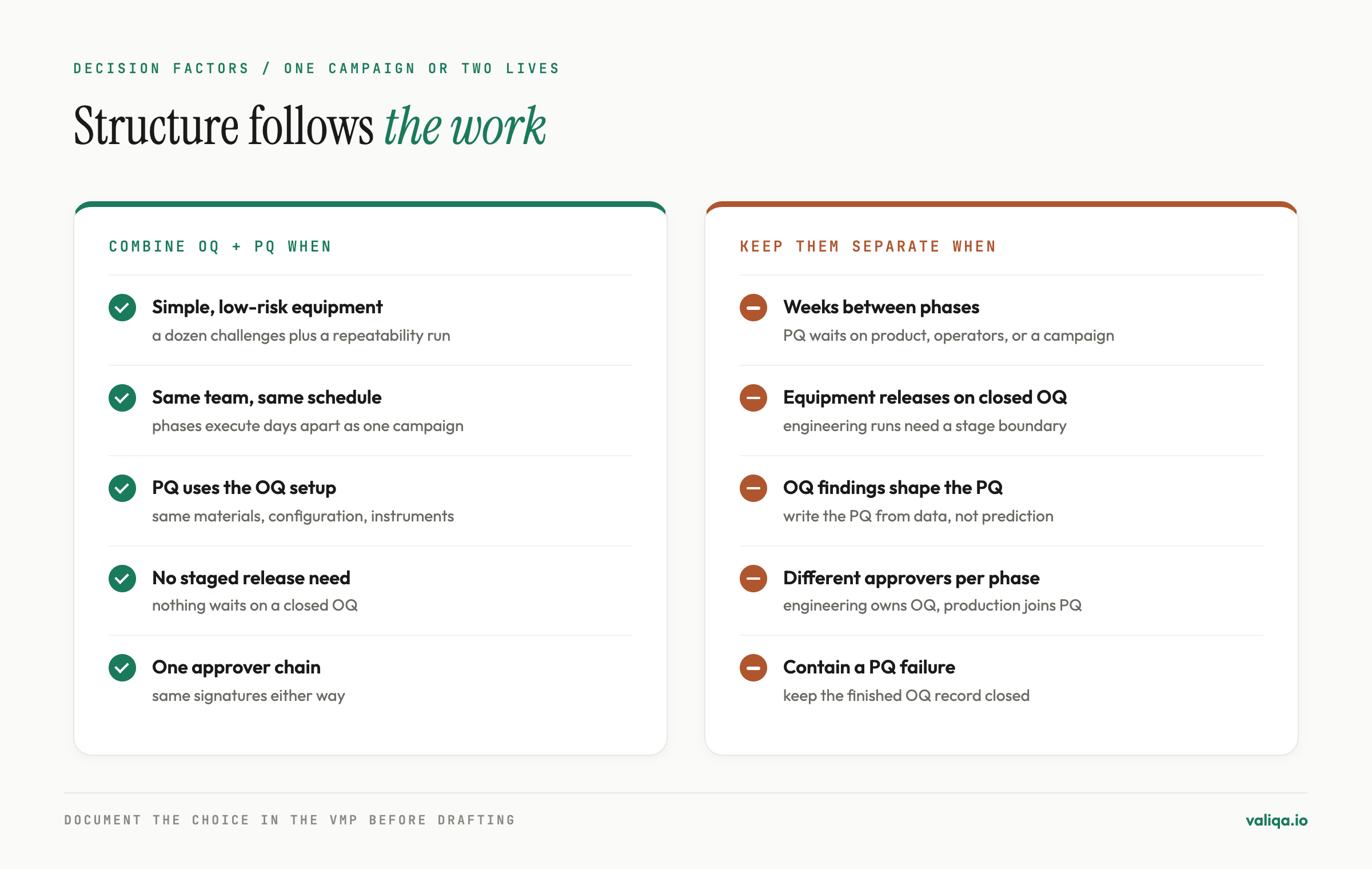
The phases run close together with the same people. If the engineer who challenges the operating ranges on Tuesday runs the performance lots on Thursday, splitting the record in two adds a signature cycle and a document number without adding control. The combined format matches how the work actually flows.
The equipment is simple or low risk. A benchtop sealer, a stirrer, a basic oven, a labeling station with a handful of parameters. Where the OQ is a dozen challenges and the PQ is a repeatability demonstration with routine materials, two full documents mean the front matter outweighs the evidence in both.
PQ can use the OQ setup. When the performance demonstration uses the same materials, the same configuration, and the same instrumentation as the range challenges, the shared test equipment section and shared references are accurate for both phases. Nothing in the front matter has to be written to cover two divergent situations.
Nobody needs the equipment released between phases. If production is not waiting on a closed OQ to start engineering runs, the main operational argument for separation disappears.
The protocol authoring cost matters. One document is genuinely cheaper to draft, route, execute, and archive than two. For a site qualifying dozens of similar low-risk assets, the saved cycles are real, an efficiency lever in the same family as the ones covered in how long it takes to write an OQ protocol.
The typical profile: utilities-fed benchtop equipment, single-owner qualification, phases executed within days of each other, no staged release requirement. For that profile the combined protocol is the leaner document and loses nothing evidentially.
When separate OQ and PQ protocols win
Separation earns its keep when the phases have different lives. The specific conditions:
Time separates the phases. PQ often needs actual product, and actual product needs scheduled production time, materials, and trained operators. If PQ will run weeks or months after OQ, a combined protocol sits open the entire time: an unclosed execution record accumulating age, personnel changes, and audit questions. Two documents let OQ close when OQ is done.
The equipment must be released after OQ. Many sites release equipment for engineering runs, media fills, or ramp-up activities on the strength of a closed OQ, with full production release waiting on PQ. That staged release needs a stage boundary, and a closed, approved OQ protocol is the cleanest one available.
OQ findings will shape the PQ. On complex equipment, the operating windows confirmed in OQ often inform the parameter settings, worst-case selections, and sample plans in PQ. Writing the PQ after OQ closes means writing it from data. A combined protocol forces both phases to be fully specified before either has run, and mid-execution protocol changes carry their own change control burden.
Different owners approve the phases. OQ commonly belongs to engineering with quality oversight; PQ pulls in production and sometimes process development. Where the approval matrix differs by phase, one signature block spanning both gets awkward: approvers are signing for content outside their responsibility, or the block fragments into qualified signatures that defeat the simplicity argument.
A PQ problem should not reopen the OQ record. In a combined document, a failed performance section holds the entire protocol open, deviations and all, even though the operating-range evidence is complete and sound. Separate documents contain the blast radius: OQ stands approved, and the PQ carries its own deviations and their resolution.
The typical profile: automated lines, product-contact equipment running hard-to-verify processes, PQ scheduled against production campaigns, multi-department approval. For that profile the combined format saves paper at the wrong price.
The traps in combined protocols
Most combined-protocol findings trace to one of three mistakes, and all three are preventable at the drafting stage.
Relabeling OQ evidence as PQ. The most common failure: the "PQ section" of a combined protocol repeats the range challenges with a different heading and calls the result a performance qualification. PQ demonstrates conforming output under routine production conditions, with representative materials, normal procedures, and run-to-run consistency. If the combined protocol's performance section would not survive as a standalone PQ, combining did not streamline the qualification. It hid a gap. The acceptance criteria discipline is the tell: OQ criteria bound parameters, PQ criteria bound output.
No hold point between phases. A combined protocol that lets PQ execution start before the OQ sections are dispositioned has removed the sequence the regulation expects. The protocol needs an explicit gate: a pre-execution check, a phase transition sign-off, or an instruction that PQ sections begin only after OQ sections pass or their deviations are assessed as not impacting performance testing. Annex 15 expects exactly this formality: clause 2.10 calls for a formal, authorised release to the next qualification stage, with conditional approval to proceed possible only on a documented assessment of the open items.
One acceptance criteria section covering both phases. Merged criteria drift toward the vague middle. Each phase needs its own criteria, phase-appropriate and individually traceable, even inside one document. The traceability matrix should show which requirement each phase's evidence satisfies, not a single undifferentiated pass.
None of these are arguments against combining. They are the drafting standards that make a combined document worth the same as two separate ones.
A worked pair
A benchtop induction sealer supports the combined format. The OQ challenges power, dwell, and seal head height at low, nominal, and high settings against foil lift and burn criteria. The PQ then runs production-representative bottles at nominal settings across three sessions with routine operators, sampled for seal quality. Same bench, same week, same engineer, same materials, one approver chain. A combined OQ/PQ protocol with a hold point between the phases documents the whole campaign in one clean record.
An automated liquid filling line supports the separate format. Its OQ spans fill volume accuracy across the pump range, line speed limits, sensor and interlock challenges, and CIP cycle verification, executed by engineering over several weeks. Its PQ needs commercial batches, production operators, and scheduling against a live production calendar, and the fill weights and reject rates from OQ inform the PQ sample plan. Quality wants the line released for engineering runs the moment OQ closes. Two protocols, sequenced, each closing on its own evidence. On the same site, the same logic that produced a combined document for the sealer produces separate documents for the line, which is exactly what a risk-based program looks like.
The same reasoning extends to the process level. Where the performance demonstration belongs to a process performance qualification that exercises the full commercial process, the equipment-level PQ question may resolve into the PPQ entirely, and the equipment record stops at OQ with the rationale documented. Combination with process validation is the second branch of the same Annex 15 allowance.
How to document the decision
The structure choice is a validation decision, and it belongs in the planning layer, not in tribal memory.
State it in the validation master plan or the equipment qualification plan. A scope table that lists the asset, the qualification stages, and the document structure, with a one-line rationale, is sufficient: "OQ and PQ combined per low-risk classification and single-campaign execution" or "separate protocols per staged release requirement." The decision framework for qualification scope and the structure decision travel together, and both should be approved before drafting starts.
Keep the criteria consistent site-wide. If the sealer got a combined protocol and an identical sealer in the next room got separate ones, an auditor will reasonably ask what rule produced the difference. A short SOP paragraph or VMP criterion, even the five factors above, converts individual document choices into a policy being followed.
Revisit on change. A combined protocol that fit the equipment at qualification does not bind future work. When revalidation is triggered, the structure question opens again with the new scope: a firmware update that requires targeted OQ re-challenge plus a performance check may fit one combined revalidation protocol even where the original qualification was separate documents, and the reverse is equally possible.
Structure follows the work
The combined-versus-separate question has no universally right answer, which is precisely why it needs a documented one. The structure should follow the shape of the actual work: one campaign, one team, one schedule points to one document; separated phases, staged release, and divided ownership point to separate documents. Both are regulator-accepted. What regulators do not accept is a performance demonstration that quietly went missing in the packaging, or a program that cannot say why its records look the way they do.
Write the decision down before drafting, hold combined protocols to standalone-PQ evidence standards, gate the phase transition, and give each phase its own acceptance criteria wherever the phases live. Do that, and the document count becomes what it should have been all along: a formatting choice, not a compliance question.
Valiqa supports both structures. It produces standalone IQ, OQ, and PQ protocols, and combined qualification documents (IQ/OQ and full IQ/OQ/PQ) that organize test steps by phase with per-phase sections, a shared traceability matrix, and a single signature block, so teams that have made the structural call can generate a protocol that matches it instead of restructuring a template by hand.
---
Valiqa is an AI-powered validation lifecycle platform for regulated manufacturing. Learn more at valiqa.io
Get new validation guides in your inbox
One or two practical guides a week, written for validation engineers. Unsubscribe anytime. Privacy policy
Frequently Asked Questions
Ready to automate your validation documentation?
Generate audit-ready IQ/OQ/PQ protocols in minutes, not weeks.
Get StartedWe use essential cookies for authentication and security. With your consent, we also use Microsoft Clarity, Google Analytics, and the LinkedIn Insight Tag on our marketing pages to understand how visitors navigate the site and to measure our advertising. Read our privacy policy.