Does a -80C Freezer Need a PQ?

Yes, if the freezer stores GMP material, it needs a performance demonstration, and for storage equipment that PQ takes a specific, well-understood shape: a loaded temperature-mapping study under routine operating conditions, plus verification that the alarm, monitoring, and recovery behavior protect the product when something goes wrong. No regulation names ultra-low temperature freezers or mandates a document titled "PQ" for them. What EU GMP Annex 15 requires is that equipment be qualified across its lifecycle at a depth justified by a documented risk assessment, and its glossary defines PQ as the documented verification that systems and equipment can perform effectively and reproducibly based on the approved process method and product specification. For a freezer, the "process" is holding the labeled storage condition with product inside, day after day, through door openings, frost accumulation, and the occasional power event. A freezer that has only been mapped empty has not demonstrated that. The honest exemptions are narrow: freezers holding no GMP material at all, and research-only units whose contents never touch a released product or a regulated study.
The question comes up in this concrete form because ultra-low freezers sit at an awkward intersection: they are storage equipment rather than process equipment, their qualification vocabulary gets borrowed from both the IQ/OQ/PQ ladder and the temperature-mapping tradition, and the product they hold, cell banks, reference standards, biological drug substance, retention samples, is often the most irreplaceable material on site. This article covers what each qualification stage looks like for a ULT freezer, what the PQ specifically demonstrates that the OQ cannot, when the scope can legitimately shrink, and how to keep the qualification defensible over years of routine use.
What the freezer holds decides the scope
The scoping logic for a ULT freezer is the same risk logic that scopes any equipment qualification: the depth of evidence follows the consequence of failure, and the consequence lives in the contents.
Released product, drug substance, and cell banks. A freezer holding material that will become, or already is, released product carries the full weight of the storage claim. The label or specification says the material is stored at minus 80 degrees Celsius, stability data stands behind that condition, and the freezer is the equipment that makes the claim true. Full qualification, including a loaded performance demonstration, is the defensible scope.
Reference standards and retention samples. These exist to anchor future decisions: an out-of-specification investigation that reaches for a retention sample stored in an unqualified freezer inherits the freezer's uncertainty. Most programs qualify these units to the same standard as product storage, and the risk assessment that says otherwise has to explain what the samples are for.
Critical reagents and intermediates for regulated studies. Material feeding stability studies, clinical manufacturing, or lot release testing sits inside the GMP boundary even when it is not itself product. The qualification scope should match the material's role, which is a judgment the validation master plan should record rather than leave to the freezer's owner.
Research-only contents. A ULT freezer in a discovery lab holding early research material, with nothing feeding a regulated filing or a released product, sits outside the GMP qualification requirement. The discipline that keeps this exemption safe is the same one that covers equipment whose output is never released: write the boundary down, and revisit it when the lab's work moves toward the clinic, because freezers outlive project phases.
The qualification ladder for a ULT freezer
The IQ/OQ/PQ structure maps onto storage equipment cleanly once each stage is read against what a freezer actually does.
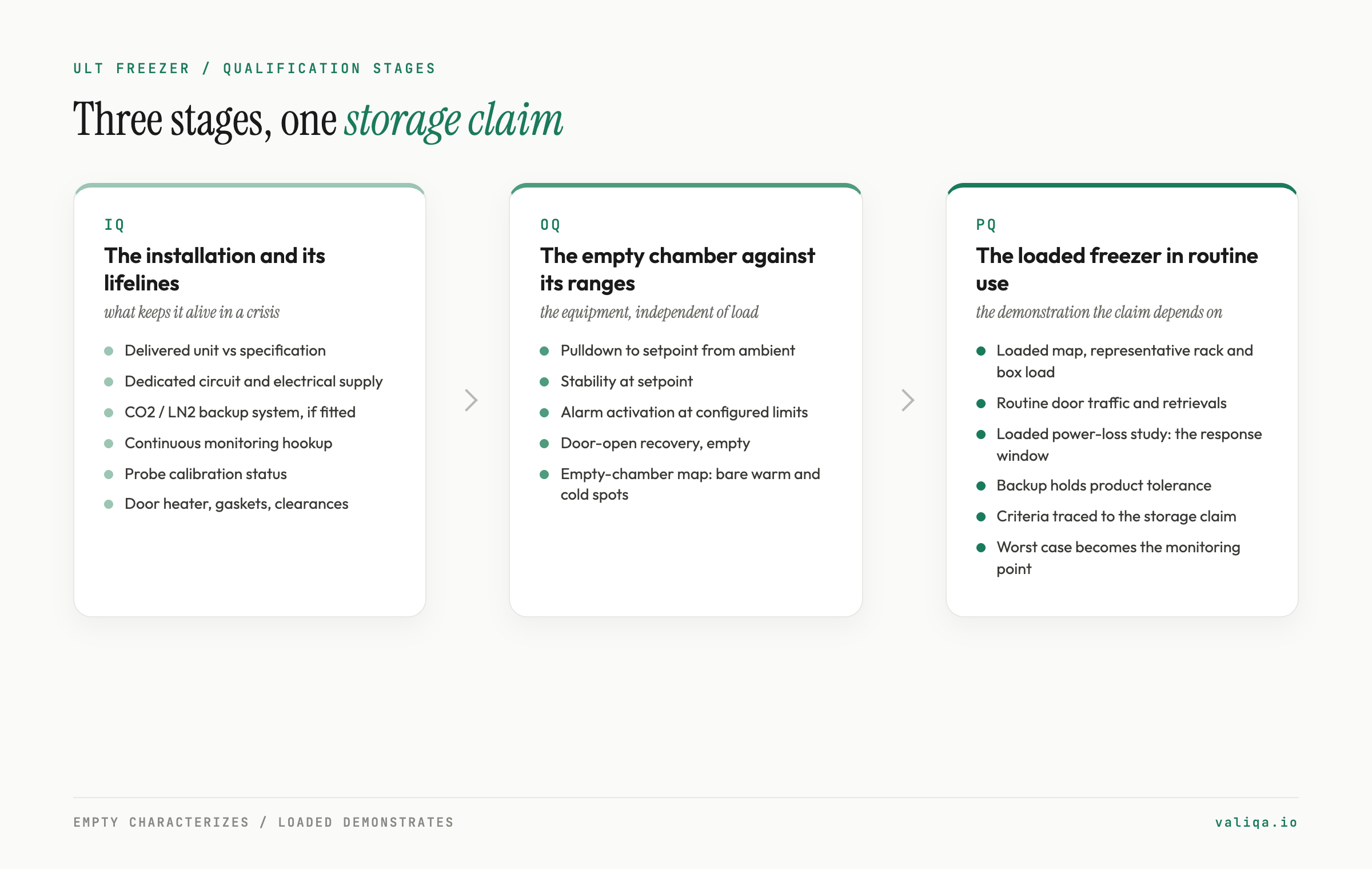
IQ: the installation and its lifelines. Beyond the standard verification of the delivered unit against specification, a ULT freezer's IQ carries items that decide how the unit behaves in a crisis: the electrical supply and any dedicated circuit, the backup system if fitted (CO2 or LN2 injection), the connection to the site's continuous monitoring system, door heater and gasket condition, clearances for the compressor cascade to reject heat, and the calibration status of the temperature probes that will generate every subsequent piece of evidence. A freezer IQ that skips the monitoring hookup and the backup system has skipped the parts an auditor will ask about first.
OQ: the empty freezer against its ranges. The OQ challenges the equipment itself: pulldown to setpoint from ambient, stability at setpoint, setpoint changes, door-open recovery on the empty chamber, alarm activation at the configured limits, and an empty-chamber temperature map that locates the warm and cold spots of the bare space. Empty mapping belongs here because it characterizes the equipment independent of any load, which is exactly the empty-versus-loaded distinction that governs mapping design generally.
PQ: the loaded freezer under routine conditions. The PQ demonstrates the thing the site actually cares about: that the freezer holds the storage condition with a representative load, under routine use, at the locations product will actually occupy. That is a loaded mapping study run under normal operating conditions, with the door openings, sample retrievals, and inventory patterns the freezer will see in service, and with the acceptance criteria traced to the storage claim rather than to the equipment brochure.
The three stages can share paper. Annex 15 explicitly allows qualification documents to be combined where appropriate, and a combined IQ/OQ or a combined qualification document with a hold point before the loaded phase is a common and defensible format for a single freezer.
What the PQ demonstrates that the OQ cannot
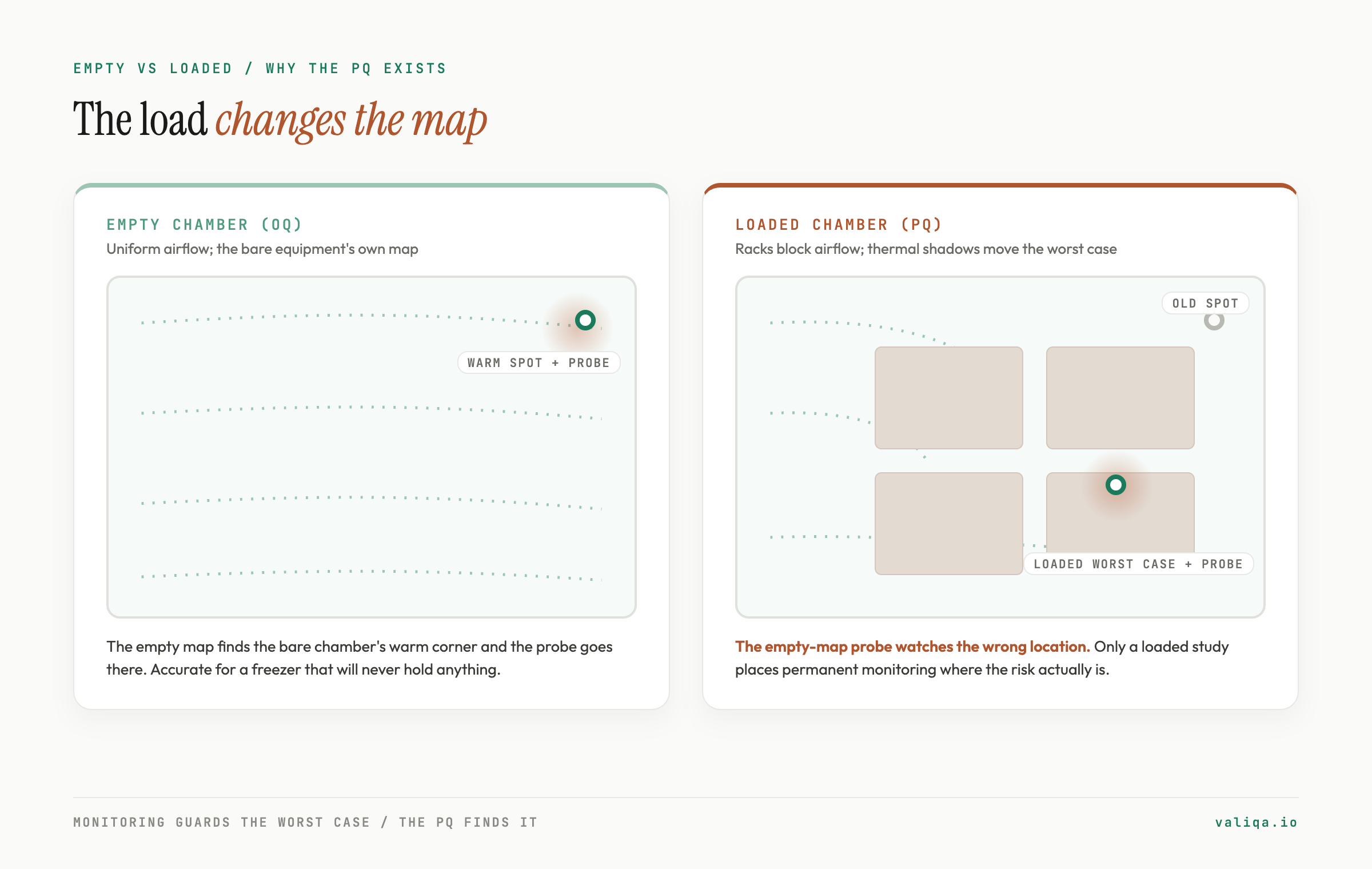
The temptation with storage equipment is to stop after a successful OQ: the empty chamber mapped tight, the alarms fired, the recovery looked fine. The gap is that an empty ULT freezer and a loaded one are different thermal systems, and the empty study cannot predict which way the differences cut.
The load changes the map. Racks, boxes, and product mass block airflow and create thermal shadows the empty map never saw. The warm spot of the empty chamber is routinely not the warm spot of the loaded one, and the monitoring probe positioned from empty-map data may be watching the wrong location. Only a loaded study places the permanent monitoring point where the risk actually is.
Routine use is the real challenge. In service, the freezer is opened, sometimes several times an hour in a busy lab, and each opening admits ambient air and humidity that the cascade has to remove again. Frost accumulates on gaskets and door frames. Inventory sessions hold the door open far longer than a single retrieval. The PQ runs the freezer through this reality, or a designed simulation of it, and shows the storage condition survives. The open-door and recovery methodology is covered in depth in the temperature mapping guide; the PQ is where that methodology meets a representative load.
Failure behavior becomes an operating limit. The power-loss or excursion-recovery study answers the question every cold-chain SOP depends on: with a full load, how long does the chamber stay below the product's tolerance ceiling when cooling stops, and how long does recovery take once it returns. That number, generated under load, becomes the response window in the outage procedure and the justification for the backup system's sizing. An empty-chamber warm-up curve does not represent the loaded case: the load's thermal mass slows warm-up, so the empty number understates the real hold time, sets an unnecessarily tight response window, and leaves the backup system unproven under the load it actually has to protect. The loaded study is the one that establishes the true window and validates the backup sizing. The same study validates the alarm-to-action chain: the excursion fires the alarm, the alarm reaches a person, and the person has a documented window to act within.
Reproducibility, not a snapshot. Annex 15's PQ definition asks for effective and reproducible performance. For a freezer that means the loaded study runs long enough to capture the operating rhythm, typically spanning normal working days with their door traffic, rather than one quiet stabilized interval, and the acceptance criteria bound every mapped location for the full duration, with excursions assessed against the product's demonstrated tolerance rather than waved through.
When the scope can legitimately shrink
The full ladder is not automatic for every freezer, and a program that qualifies everything identically is not being rigorous, it is declining to make decisions. The defensible reductions:
Non-GMP contents. As covered above, the research-only freezer needs no GMP qualification, just the documented and periodically reconfirmed boundary, the same honest exemption that applies across equipment scoping decisions.
Wide product tolerance. Where the stored material's specification demonstrates tolerance far wider than the freezer's operating band, the risk assessment can support a leaner PQ: fewer mapped locations, a shorter loaded study, or a monitoring-weighted approach in which the qualified continuous monitoring at worst-case locations carries more of the ongoing burden. The reduction is a documented risk decision, not a default.
Fleet and family approaches. Sites running many identical freezers in the same environment sometimes qualify a lead unit fully and bracket the rest with reduced studies plus per-unit IQ and monitoring. The justification has to establish that the units, their loads, and their environments are genuinely comparable, and per-unit empty mapping with per-unit monitoring probes remains the common floor, because chambers of the same model still differ as built.
Rented or loaner freezers. A rental ULT unit covering a failure inherits the scoping logic of temporary equipment: the GMP function decides that qualification happens, vendor and fleet documentation can carry much of the IQ, and the performance evidence should match the deployment, commonly a compressed loaded verification at the monitoring points plus enhanced monitoring for the rental period, justified in the change record.
What does not shrink the scope: the argument that continuous monitoring alone replaces qualification. Monitoring tells you the temperature at the probe, every minute, forever. It does not tell you the probe is at the worst-case location, and it cannot, because only a mapping study under load answers that. Monitoring and qualification are complements: the PQ finds the worst case, and monitoring then stands guard there.
Keeping the qualification alive
A ULT freezer's qualification is not a one-time event, because the freezer, its load, and its duty change over years of service.
Requalification on a justified cycle. Annex 15 expects equipment to be evaluated at an appropriate frequency to confirm it remains in a state of control, with the period justified, the criteria for evaluation defined, and the possibility of small changes over time assessed. For ULT freezers, compressor cascades age, gaskets wear, and frost management degrades, all in the direction of warmer excursions and slower recovery. Many programs pair a periodic review of monitoring and alarm data with a risk-based remapping interval, and the requalification triggers apply on top: repair of the refrigeration system, relocation, a changed load pattern, or a drift trend in the monitoring record each reopen the question ahead of schedule.
Change control on the load. The PQ demonstrated a representative load. A freezer that was mapped half-full and now runs packed to the door, or that switched from boxed vials to dense racked plates, is operating outside its demonstrated configuration. Load-pattern limits belong in the freezer's use SOP, and a material change in loading is a change-control trigger, not a housekeeping detail.
The monitoring record as living evidence. Between qualifications, the continuous monitoring record at the mapped worst-case location is the standing demonstration that the storage condition holds. Excursion handling, alarm response times, and periodic data review are what an auditor reads to decide whether the qualification still describes the freezer in front of them. A clean PQ binder next to an unreviewed monitoring record with unexplained excursions is not a qualified freezer, it is a well-documented historical artifact.
A worked scope, end to end
A biotech site installs a new ULT freezer for master cell bank storage at minus 80 degrees Celsius. The contents are irreplaceable, so the risk assessment lands on full qualification. The IQ verifies the delivered unit, the dedicated circuit, the LN2 backup injection system, the monitoring system connection, and probe calibration. The OQ pulls the empty chamber down, challenges setpoint stability and alarms, and maps the empty space with calibrated loggers. The PQ loads the chamber with a representative rack-and-box configuration, maps for a full working week under the freezer's expected access pattern, which for a cell bank unit is infrequent and controlled, runs a designed door-open challenge and a loaded power-loss study that establishes the response window, and confirms the LN2 backup holds the chamber within the product tolerance during the outage. The worst-case location from the loaded map becomes the permanent monitoring point, the acceptance criteria all traced to the cell bank's storage specification, and the whole exercise lives in a combined qualification document with hold points between stages. Requalification is set on a justified interval with monitoring-data review in between, and the load configuration is bounded in the SOP.
A second freezer in the same facility holds early-discovery research samples only. The assessment documents the non-GMP boundary, the unit gets an installation check and monitoring for scientific reasons, and no GMP qualification is claimed. Two freezers, two scopes, one defensible logic, which is what a risk-based program looks like on paper.
The storage-claim test
Strip the question to its core and the answer is compact. A minus 80 freezer exists to make a storage claim true, and a PQ is how the site proves the claim holds with product inside, under real use, at the locations that matter, through the failures that will eventually happen. If the contents carry a GMP storage condition, that proof is required, and for storage equipment it takes the form of a loaded mapping study plus alarm and recovery verification rather than a production-style protocol. If the contents genuinely carry no GMP weight, the proof is a documented decision instead. What no program gets to skip is the decision itself.
Valiqa generates qualification protocols for storage equipment from the equipment's actual context, including IQ, OQ, and PQ documents and combined formats with phase hold points, with acceptance criteria structured to trace back to the storage claim, so the freezer on the dock gets a right-sized protocol instead of a blank template.
---
Valiqa is an AI-powered validation lifecycle platform for regulated manufacturing. Learn more at valiqa.io
Get new validation guides in your inbox
One or two practical guides a week, written for validation engineers. Unsubscribe anytime. Privacy policy
Frequently Asked Questions
Ready to automate your validation documentation?
Generate audit-ready IQ/OQ/PQ protocols in minutes, not weeks.
Get StartedWe use essential cookies for authentication and security. With your consent, we also use Microsoft Clarity, Google Analytics, and the LinkedIn Insight Tag on our marketing pages to understand how visitors navigate the site and to measure our advertising. Read our privacy policy.