Traceability Matrix in Validation: Example, Audit Tips
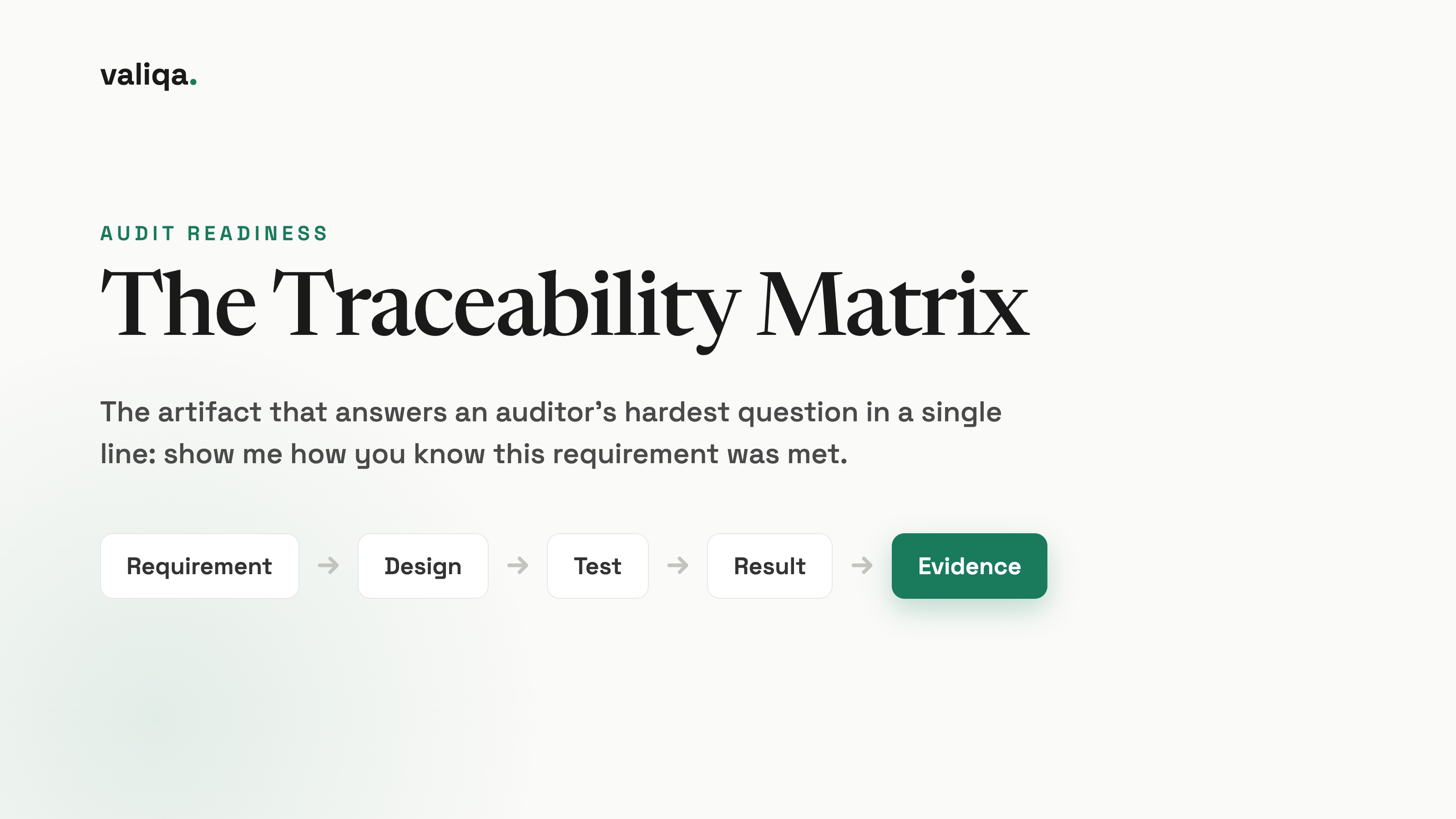
There is a question that separates a validation program that will pass an audit from one that will struggle, and it is deceptively simple. The auditor points at a single requirement, maybe a sterilization temperature or a data-integrity control, and asks: show me how you know this was met. A program with a working traceability matrix answers in one line and moves on. A program without one sends three people digging through protocols, execution records, and email threads for the rest of the afternoon.
The traceability matrix is the artifact that turns a pile of qualification documents into a defensible chain of evidence. It is also the artifact most teams treat as an afterthought, built the week before an audit by copying protocol titles into a spreadsheet. Built that way it is a liability, because a matrix that does not actually reflect coverage is worse than no matrix at all.
This guide covers what a validation traceability matrix is, the columns that make it useful, why tracing in both directions catches problems a one-way matrix misses, how it scopes change control, and how to keep it from drifting out of date.
What a traceability matrix actually is
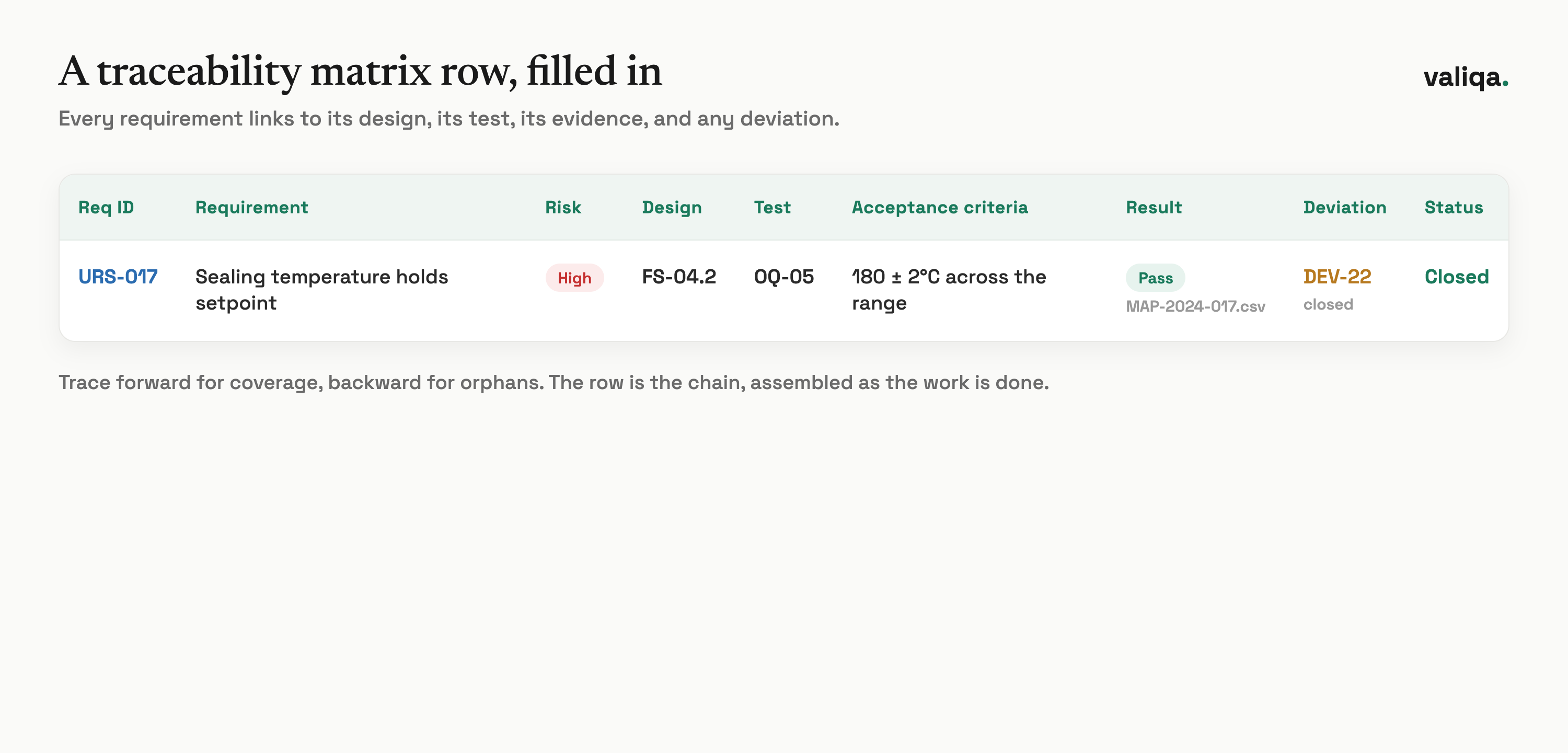
A traceability matrix is a controlled table that links every requirement to the design that satisfies it, the test that verifies it, the result that proves it, and any deviation raised against it. In validation, the requirements come from the User Requirements Specification, or URS. The tests come from the IQ, OQ, and PQ protocols. The proof comes from the executed records. The matrix is the single place where all of those connect.
The point of the matrix is not documentation for its own sake. It answers two questions that an inspector, and a good quality team, will always ask. First, is every requirement tested? A requirement with no test behind it is a gap in coverage. Second, does every test trace to a requirement? A test with no requirement behind it is either scope creep or a sign the requirements are incomplete. Only a matrix that traces in both directions can answer both questions, which is why one-way matrices give a false sense of completeness.
The matrix is the connective tissue for the whole equipment qualification lifecycle. If you want the map of where IQ, OQ, and PQ each sit, the complete guide to IQ, OQ, and PQ lays out the stages the matrix threads together. If your matrix carries a risk column, its entries should come from a documented PFMEA risk analysis, not ad-hoc judgment.
The anatomy of a useful matrix
A traceability matrix is only as good as the columns it carries. Too few and it cannot answer the coverage question. Too many and no one keeps it current. The set below is the working minimum for equipment and process qualification.
Requirement ID. A stable identifier for each URS requirement, such as URS-017. The ID, not the requirement text, is what everything else references. Matrices that key on copied requirement text instead of IDs break the moment the wording is edited.
Requirement text. A short statement of the requirement, so the row is readable without opening the URS.
Source and risk. Where the requirement came from and its risk classification. Risk matters because it justifies how much test rigor the requirement gets, and an auditor will look for that link between risk and depth of testing.
Design reference. The design element that satisfies the requirement, such as a functional specification section or a drawing number. This is the link that a good Design Qualification establishes first, before any test is written.
Protocol and test ID. The specific protocol and test step that verifies the requirement, such as OQ-05. This is the forward link from requirement to evidence.
Acceptance criteria. The objective pass or fail condition for the test. Writing these well is a discipline of its own, covered in the guide on acceptance criteria that will not get flagged in an audit.
Result and record reference. The outcome and a pointer to the executed evidence, such as a data file or attachment reference. This is what makes the row a chain of evidence rather than a plan.
Deviation reference. Any deviation raised against the requirement or its test, with its identifier. A blank here should mean clean, not unrecorded.
Status. Open, executed, passed, or closed. This is what lets the matrix double as a live coverage dashboard during execution.
Forward and backward tracing catch different problems
The single most common weakness in a traceability matrix is that it only traces one way. Tracing forward, from each requirement to its test, catches untested requirements. Tracing backward, from each test to its requirement, catches orphan tests. These are different failures and you need both directions to find both.
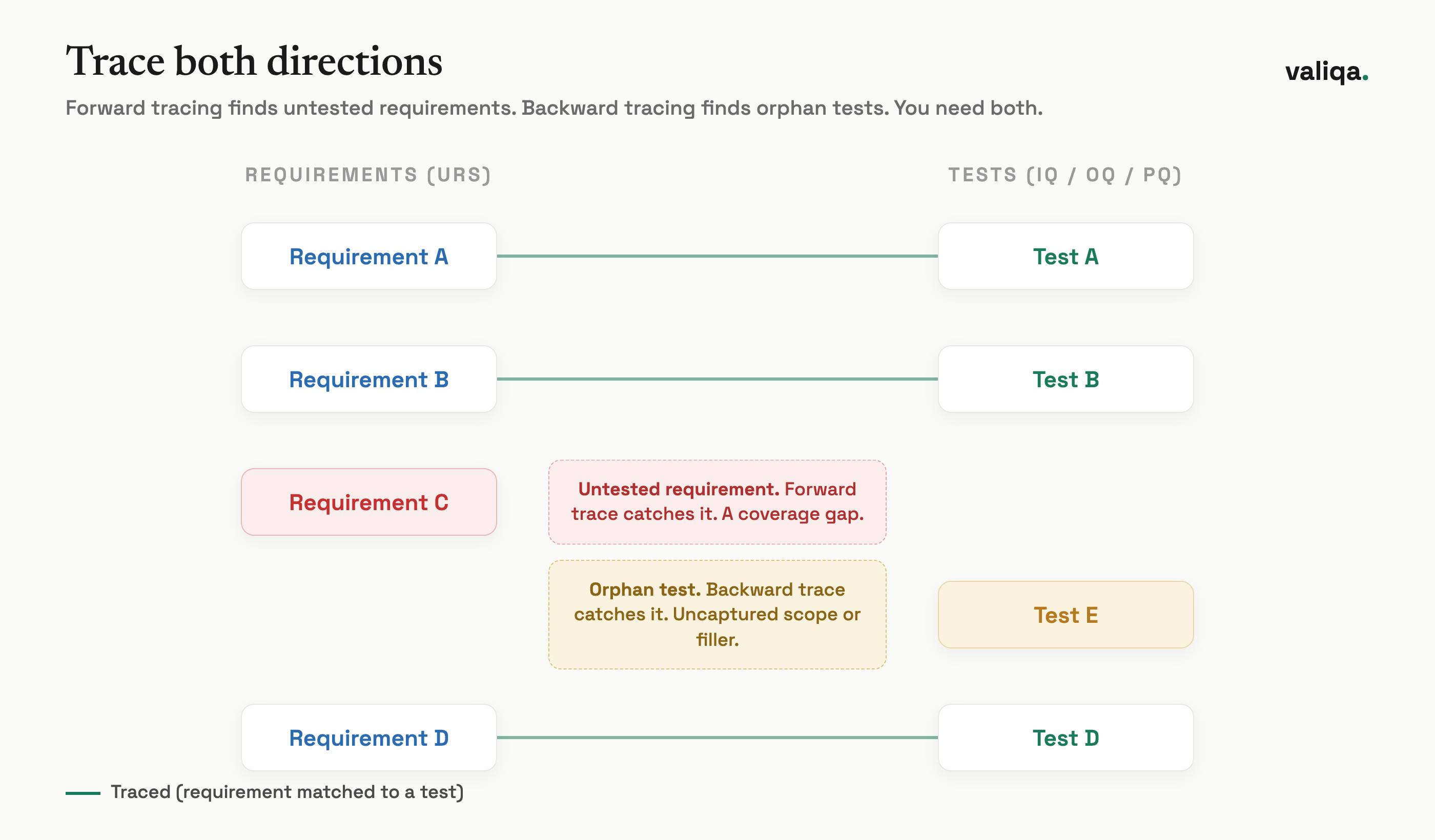
An untested requirement is the gap auditors probe for. The URS said the system must retain audit-trail records for a defined period, and no protocol tests it. The requirement exists on paper, the assurance does not exist in evidence, and the matrix, traced forward, shows the empty cell.
An orphan test is subtler and often more revealing. A test exists in the OQ that traces to no requirement. Two things could be true. The test might be genuine scope that was never captured in the URS, which means the requirements are incomplete. Or the test might be legacy filler carried over from a template, which means effort is being spent proving something no one asked for. Either way, the orphan is a signal, and only backward tracing surfaces it.
Running both traces and documenting the result is called coverage analysis, and it is the step that turns a matrix from a table into an assurance argument. The honest output of a coverage analysis is not always one hundred percent with no orphans. It is a documented account of every gap and every orphan, each with a disposition. That is what a reviewer trusts, because it shows the analysis was actually performed.
A worked example: one requirement, end to end
Concrete beats abstract. Follow a single requirement through the chain.
URS-017 states that a sealing process must hold a temperature of 180 degrees C within a tolerance of plus or minus 2 degrees C, because the seal integrity depends on it. In Design Qualification, URS-017 traces to functional specification section FS-04.2, which specifies the controller and sensor capable of holding that setpoint. In the OQ, test OQ-05 challenges the setpoint across the operating range, with the acceptance criterion that the measured temperature stays within 180 plus or minus 2 degrees C. Execution produces a data file, MAP-2024-017.csv, captured as the record. During execution one run drifts out of tolerance, raising deviation DEV-22, which is investigated and closed with a corrective action. The validation summary report references the whole chain in Section 7.2.
Now the auditor asks the hard question about seal temperature. The answer is a single traced line: URS-017 to FS-04.2 to OQ-05 to MAP-2024-017.csv to DEV-22 to summary Section 7.2. Requirement, design, test, evidence, deviation, conclusion. No digging. The matrix did the work months earlier, at the point where each link was created rather than reconstructed under pressure. This is the same chain discipline that runs through everything auditors look for, covered in what auditors actually look for in validation documentation.
The matrix is how you scope change control
The traceability matrix earns its keep a second time, long after the initial qualification, whenever something changes. When a requirement, a design element, or a piece of equipment changes, the question is always the same: what does this affect, and what has to be re-tested. A current matrix answers it directly. Trace forward from the changed requirement or design reference and every downstream test that touches it lights up. That set is your re-validation scope.
Without the matrix, change impact is a matter of memory and hope, which is exactly how requirements get missed during revalidation. With it, the impact assessment is a query, not a guess. Deciding when a change actually triggers re-testing is its own topic, covered in the guide on when you actually need to redo IQ, OQ, and PQ; the matrix is what tells you how far that re-testing has to reach.
Common ways the matrix goes wrong
A few failure modes show up again and again.
Built after the fact. A matrix assembled the week before an audit, by copying protocol titles into a spreadsheet, documents nothing that was not already true and often papers over gaps rather than exposing them. The matrix has to be built as the requirements and protocols are, so it reflects real coverage.
One-way only. Forward tracing without backward tracing leaves orphan tests invisible and requirements potentially incomplete. Both directions or it is not coverage.
Keyed on text, not IDs. When rows reference copied requirement wording instead of stable IDs, a single edit to the URS silently breaks the links, and no one notices until an audit finds the mismatch.
Stale after changes. A matrix that is not updated when requirements or designs change becomes actively misleading, because it asserts coverage that no longer holds. A wrong matrix is worse than none.
Spreadsheet drift. Manual matrices maintained by hand across many contributors accumulate copy errors, version confusion, and broken references. The larger the system, the faster a hand-maintained spreadsheet degrades.
Where regulators expect it
Requirements traceability is not a nice-to-have that regulators tolerate. It is an expectation woven through the frameworks. EU GMP Annex 15 frames qualification as a documented progression from design through installation, operation, and performance, which only holds together if requirements trace across the stages. GAMP 5 Second Edition makes requirements traceability an explicit part of its specification and verification approach for computerized systems, with the traceability matrix as a core deliverable. For medical device manufacturers, design controls under ISO 13485:2016 Section 7.3 are now the anchor for US requirements through the Quality Management System Regulation, effective February 2, 2026. Those controls expect design outputs to trace to design inputs, and verification to trace to both. Across all of them, the underlying data-integrity principle is the same: the evidence must be attributable and traceable, which is precisely what the matrix provides.
How Valiqa fits
Valiqa builds the traceability matrix as it generates the qualification protocols, rather than leaving it as a manual reconstruction afterward. Each generated test step carries its link back to the requirement and the applicable regulatory reference, so the forward chain from requirement to test exists from the moment the protocol is created, and the matrix can be exported as a controlled artifact. Because the matrix is generated from the same structured content as the protocols, it does not drift out of sync with them the way a hand-maintained spreadsheet does. The engineer still owns the requirements and the judgment about coverage. The tool keeps the links intact across every stage of the lifecycle.
A traceability matrix is not glamorous work, but it is the artifact that decides whether your validation evidence holds together under questioning. Build it as you go, trace it in both directions, keep it current through change, and the auditor's hardest question becomes your easiest answer.
---
Valiqa is an AI-powered validation lifecycle platform for regulated manufacturing. Learn more at valiqa.io
For how this matrix anchors each link to its predicate regulation across all three qualification stages, see IQ OQ PQ protocols with regulatory traceability.
Get new validation guides in your inbox
One or two practical guides a week, written for validation engineers. Unsubscribe anytime. Privacy policy
Frequently Asked Questions
Ready to automate your validation documentation?
Generate audit-ready IQ/OQ/PQ protocols in minutes, not weeks.
Get StartedWe use essential cookies for authentication and security. With your consent, we also use Microsoft Clarity, Google Analytics, and the LinkedIn Insight Tag on our marketing pages to understand how visitors navigate the site and to measure our advertising. Read our privacy policy.