Does Temporary Equipment Need an IQ?

Yes, if the equipment performs a GMP-impacting function, it needs an IQ, and the fact that it is rented, borrowed, or on site for six weeks does not change that. No major regulation recognizes "temporary" as a category that exempts equipment from qualification. EU GMP Annex 15 states that IQ should be performed on equipment, facilities, utilities, or systems, with no qualifier about ownership or duration, and its General section ties the scope and extent of qualification to a justified and documented risk assessment, not to how long the equipment stays. The product a rented chiller cools or a loaner sealer seals does not know the equipment is temporary. What temporary status legitimately changes is the depth of the IQ and where the evidence comes from: vendor qualification packages, fleet documentation, FAT records, and calibration certificates can carry much of the load, so a right-sized IQ for a rental unit is often a short document. Equipment used only for engineering trials or development runs, where no output is released as product, is the main case that genuinely falls outside the qualification requirement.
This question comes up constantly in practice because temporary equipment arrives under time pressure: a compressor fails mid-campaign, a chiller goes down in July, a loaner filler bridges a repair, a trial unit shows up for evaluation. The pressure to skip qualification is real, and so is the audit finding when a rented unit ran product-contact operations for three months with no installation record. This article covers what counts as temporary equipment, why duration is not the deciding variable, the questions that actually decide, what a right-sized IQ looks like when the answer is yes, and how to document the cases where the answer is no.
What counts as temporary equipment
Temporary equipment shows up in a handful of recurring forms, and it is worth naming them because each has a different risk profile.
Rental utilities and support equipment. Rented chillers, boilers, air compressors, dehumidifiers, and generators, typically brought in to cover a failure, a maintenance window, or a seasonal capacity gap. These rarely touch product directly, but they feed systems that do: a rental chiller holding jacket temperature on a reactor, a rented compressor supplying the compressed air that operates product-contact valves.
Loaner and backup process equipment. A vendor's loaner unit covering a repair, a sister site's spare sealer, a backup pump swapped in during overhaul. These usually perform exactly the function of a qualified unit, which makes them the clearest case: whatever made the original equipment worth qualifying applies to its stand-in.
Trial and demonstration units. Equipment on site for evaluation before purchase. Whether these need qualification depends entirely on what runs through them, which is the subject of the next section.
Short-campaign equipment. Equipment brought in for a defined production campaign: a rented lyophilizer for a single product run, contract packaging equipment installed for a seasonal campaign, mobile cleanroom units. The installation is temporary; the product made on it is as permanent as any other.
The common thread is that none of these categories appears in any regulation. Annex 15's Principle applies qualification to the facilities, equipment, utilities, and processes used for manufacture, full stop. The IQ, OQ, and PQ breakdown that governs permanent equipment is the same framework a temporary unit is measured against.
Why "temporary" is not a regulatory category
Regulations scope qualification by impact, not tenure. Annex 15 clause 3.8 says IQ should be performed on equipment, facilities, utilities, or systems. Its glossary defines lifecycle as all phases from initial development or use through to discontinuation of use, and clause 3.1 expects qualification to consider all stages from the user requirements specification through to the end of use. A lifecycle that lasts eight weeks is still a lifecycle, and end of use is a defined event for temporary equipment rather than a distant one.
The device side reads the same way. ISO 13485:2016 clause 7.5.6 requires validation of processes whose output cannot be, or is not, verified by subsequent monitoring or measurement, and the FDA Quality Management System Regulation, in effect since February 2, 2026, incorporates ISO 13485:2016 into 21 CFR Part 820 by reference. The GHTF process validation guidance that shaped device qualification practice describes IQ as establishing by objective evidence that all key aspects of the equipment and ancillary system installation adhere to the approved specification and that supplier recommendations are suitably considered. None of these texts asks how long the equipment will stay. A sealing process run on a loaner sealer is exactly as hard to verify by inspection as the same process on the qualified unit it replaced.
There is also a straightforward audit logic here. An auditor who finds product manufactured on equipment with no installation record does not care about the rental agreement. The batch record names the equipment, the equipment has no qualification status, and the documentation trail auditors walk breaks at that point. Findings on temporary equipment are not findings about duration. They are findings about equipment that did GMP work without evidence it was fit to.
The questions that actually decide
The decision reduces to the same risk questions that scope qualification for any equipment, asked honestly about the temporary unit.
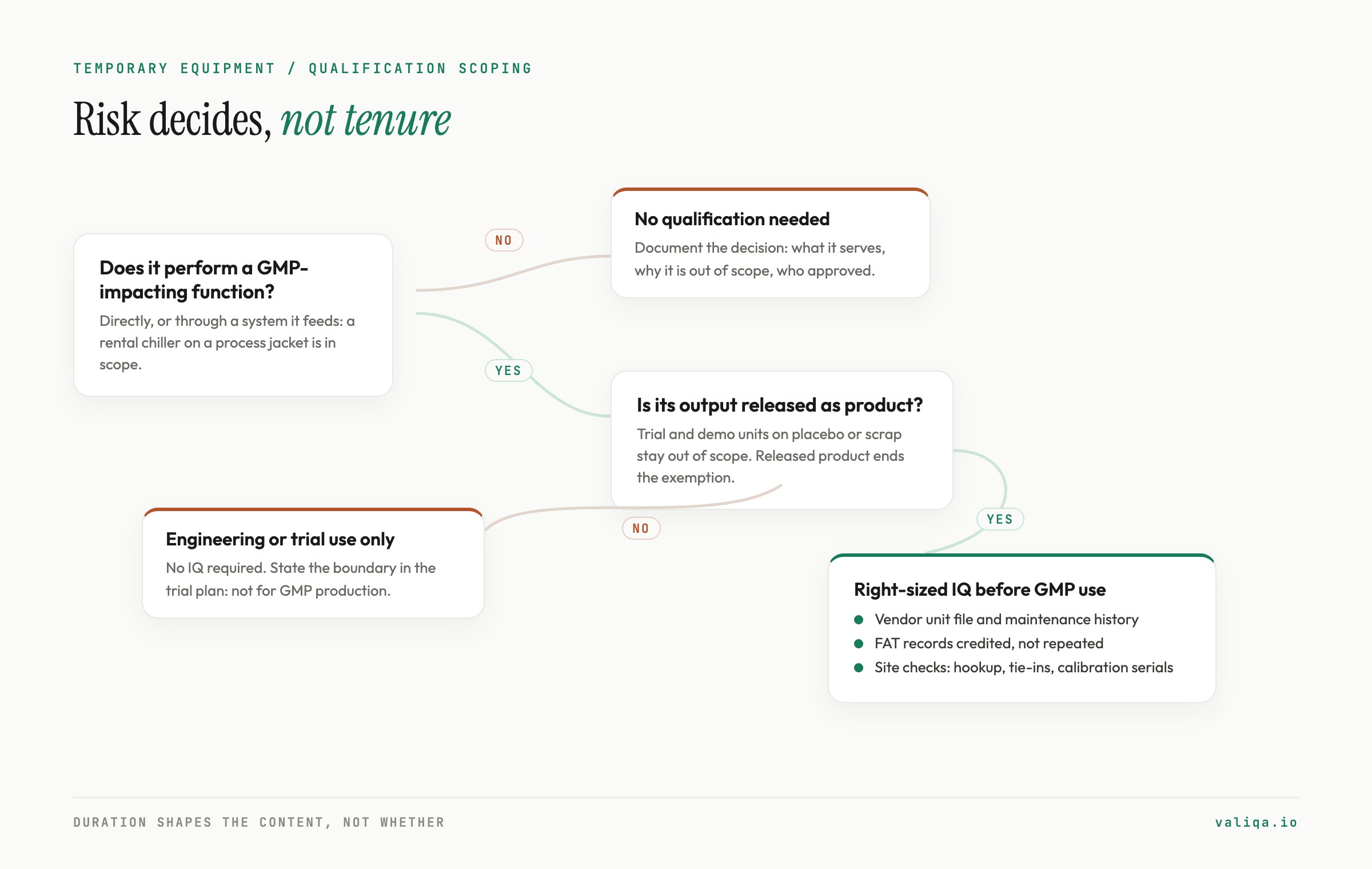
Does it perform a GMP-impacting function? If the equipment's operation can affect product identity, strength, quality, purity, or safety, directly or through a system it feeds, it is in scope. A rental chiller on a comfort-cooling loop for an office wing is out. The same chiller holding a jacketed vessel at process temperature is in.
Will its output be released as product? Equipment used exclusively for engineering runs, development batches, or operator training, where nothing it touches is released, sits outside the qualification requirement. This is the honest exemption for most trial and demonstration units: evaluate the machine on placebo or scrap material and no IQ is required. The moment a trial unit runs saleable product, the exemption is gone. Annex 15 clause 5.9 makes the same point for validation batches: equipment used for process validation should itself be qualified.
Is it replacing a qualified unit? A loaner or backup standing in for qualified equipment inherits the original's risk profile, and the swap itself is a change. Annex 15 section 11 expects written change control procedures covering planned changes to equipment, with quality risk management used to evaluate the impact and to plan any necessary qualification effort. The change record is where the temporary unit's qualification scope gets decided and justified, which is also what makes the decision auditable.
What does the duration actually affect? Duration legitimately influences things like whether seasonal variation matters for a utility, whether requalification intervals will ever come due, and how much monitoring accompanies the use period. Annex 15 clause 8.2 says the period and extent of utility qualification should reflect seasonal variations, if applicable, and the intended use of the utility. Duration shapes the qualification content. It does not decide whether qualification happens.
The decision framework for IQ-only versus full IQ/OQ/PQ applies unchanged from this point: answer what the equipment does, and the scope follows.
When temporary equipment genuinely does not need an IQ
The honest no-IQ cases are narrow but real, and writing them down keeps the program credible.
Non-GMP service. Equipment whose failure cannot affect product quality through any path: comfort HVAC, office equipment, a rental generator feeding only non-GMP loads. The classification should survive a walk of the actual connections, because a "non-GMP" compressor that turns out to feed a product-contact air line is a finding waiting to happen.
Engineering and development use only. Trial units, demo equipment, and rented capacity used for feasibility runs, engineering studies, or training, with no output released. The discipline that keeps this exemption safe is a boundary: a note in the trial plan or equipment log stating the unit is not for GMP production, so the status is explicit rather than assumed.
Fully verified output, for device manufacturers. Under ISO 13485:2016 clause 7.5.6 and the QMSR, process validation attaches to processes whose output is not fully verified. If the output of the operation running on the temporary equipment is 100 percent verified downstream, the process validation requirement does not attach, and the equipment case follows the same logic as when a PQ is not required. Even then, most sites still record an installation check for the temporary unit, because calibration status and correct hookup are worth evidencing regardless of validation scope.
What does not belong on this list: urgency. A breakdown does not create an exemption. It creates a case for a fast, right-sized IQ and, where justified, a conditional release, both of which the regulations explicitly support.
What a right-sized IQ for temporary equipment looks like
The reason teams resist qualifying temporary equipment is that they picture the full protocol built for a permanent installation. The regulations do not require that. They require the IQ elements, scaled by risk, and they explicitly allow most of the evidence to come from outside the site's own program.
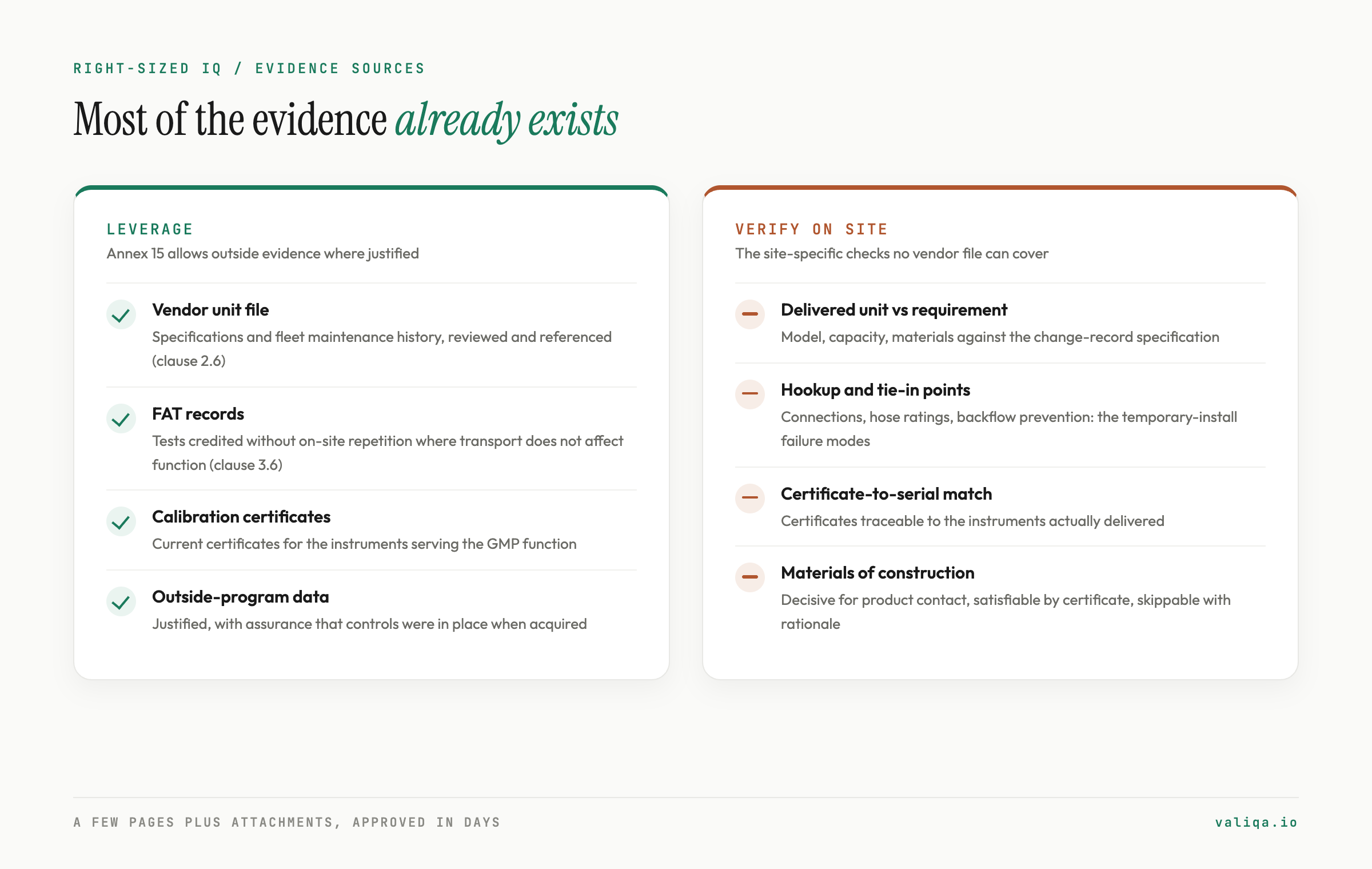
Annex 15's General section allows data supporting qualification obtained from sources outside the manufacturer's own program, provided the approach is justified and there is adequate assurance that controls were in place when the data was acquired. Clause 2.6 addresses vendor-supplied validation documents directly: where protocols and documentation are supplied by a third party, site personnel should confirm suitability and compliance with internal procedures before approval, and may supplement them. Clause 3.6 allows documentation review and testing performed at FAT to stand without repetition at IQ, where justified, if functionality is not affected by transport and installation. For rental fleets, this is exactly the situation: reputable rental vendors maintain per-unit files with specifications, maintenance history, and current calibration certificates, and a competent IQ leans on them.
The site's job is to cover the five IQ elements Annex 15 clause 3.9 lists at minimum, at a depth matching the risk:
Installation verification against specifications. Confirm the unit delivered is the unit specified: model, capacity, materials, utilities connections against the requirement that brought it on site. For a rental, the "specification" may be a one-page requirement in the change record rather than a full URS, which is appropriate when the design qualification thinking happened at fleet-selection level.
Verification against pre-defined criteria. Correct hookup, correct orientation, clearances, drains, filters in place. For temporary connections, this is where tie-in points, hose ratings, and backflow prevention get verified, the failure modes unique to temporary installation.
Collection of supplier instructions and maintenance requirements. The vendor's operating manual and the rental file. For a short deployment, collation may be a reference to the vendor document set rather than a copied binder.
Calibration of instrumentation. Current certificates for the instruments that matter to the GMP function, traceable to the units actually delivered. Serial-number mismatches between certificates and delivered instruments are a classic finding on rented equipment.
Verification of materials of construction. Decisive for product-contact equipment, often satisfiable by certificate for a rental unit, and skippable with rationale where there is no contact path.
An IQ built this way for a rental chiller is commonly a few pages plus attachments. The acceptance criteria are pass/fail verifications against the delivered documentation, and the protocol can be drafted and approved in days, not weeks. Where operating checks are also needed, the IQ and OQ portions are natural candidates for a combined document, which Annex 15 clause 2.5 explicitly permits.
A worked example: the rental chiller
A jacketed-vessel chiller fails in mid-campaign and a rental replacement arrives in 48 hours. The process needs jacket supply at 7 degrees C plus or minus 2, and the chiller is a utility feeding a qualified system, so it is GMP-impacting and in scope.
The change record opens the same day, states the requirement, and defines the qualification scope: IQ for the rental unit, a short operating check, and enhanced monitoring for the deployment period in place of a formal PQ, justified because the downstream process alarms on jacket temperature excursions. The IQ verifies the delivered model and capacity against the requirement, the glycol connections and tie-in points against the pre-defined hookup criteria, collects the vendor's unit file, and checks the calibration certificates for the supply and return temperature sensors against delivered serial numbers. The vendor's fleet maintenance records are accepted under the Annex's allowance for qualification data from outside sources, reviewed and referenced rather than recreated. The operating check confirms stable supply temperature at setpoint under process load. Where the temperature performance of a chamber or a load matters in its own right, the same deployment would also trigger the performance scoping covered in whether a -80C freezer needs a PQ and the mapping discipline covered in temperature mapping and thermal validation.
Total qualification effort: roughly two days of document work and checks, run in parallel with installation. If the campaign timeline is tighter than the paperwork, Annex 15 clause 2.10 allows conditional approval to proceed to the next qualification stage, with the open items documented and assessed as having no significant impact on the next activity. Where product must be made before the validation program fully closes, that is concurrent validation territory under Annex 15 section 5: justified, documented in the VMP, and formally approved, not quietly tolerated. When the permanent chiller returns, the change record closes with the rental's end of use, and the batch records for the deployment period name a unit whose qualification status is a document, not a shrug.
Document the no cases too
The decision that a temporary unit does not need qualification is itself a decision an auditor will test, and it should exist on paper. The clean pattern is a short assessment in the change record or equipment log: what the equipment is, what it serves, why it is out of scope (non-GMP service, engineering use only, fully verified output), and who approved that reasoning. The site's validation master plan is the place to state the policy once: temporary and rental equipment follows the same risk-based qualification scoping as permanent equipment, with vendor documentation leveraged where justified.
Two boundary rules keep the program honest over time. First, time-bound the temporary status. A rental chiller still running after eleven months is not temporary, and several sites have discovered at requalification review that a "bridge" unit quietly became permanent infrastructure with a bridge-sized qualification file. A defined end date, or a trigger to convert to full qualification if the deployment extends, closes that gap. Second, treat removal as a change too: the swap back to the permanent unit goes through the same change control as the swap out, so the record shows a closed loop.
The tenure test
Strip away the edge cases and the rule is compact. Qualification scope follows risk, risk follows what the equipment does, and what the equipment does is unaffected by who owns it or how long it stays. A temporary unit doing GMP work needs an IQ proportionate to its risk, built substantially from vendor and fleet evidence the regulations already allow you to use. A temporary unit doing non-GMP work, or engineering-only work, needs a documented decision that says so. Urgency changes how fast the IQ happens and how much of it leans on third-party documentation. It does not change whether it happens.
Teams that internalize this stop having the temporary-equipment argument at 4 pm on a Friday with a rental on the dock, because the policy already exists, the scoping questions are already written down, and the IQ shell is a known quantity.
Valiqa generates right-sized IQ protocols from the equipment's actual context, including standalone IQ documents and combined IQ/OQ formats suited to rental and loaner deployments, so a qualification that has to happen in days starts from a draft in minutes instead of a blank template.
---
Valiqa is an AI-powered validation lifecycle platform for regulated manufacturing. Learn more at valiqa.io
Get new validation guides in your inbox
One or two practical guides a week, written for validation engineers. Unsubscribe anytime. Privacy policy
Frequently Asked Questions
Ready to automate your validation documentation?
Generate audit-ready IQ/OQ/PQ protocols in minutes, not weeks.
Get StartedWe use essential cookies for authentication and security. With your consent, we also use Microsoft Clarity, Google Analytics, and the LinkedIn Insight Tag on our marketing pages to understand how visitors navigate the site and to measure our advertising. Read our privacy policy.