Validation Master Plan Template (Free Download)
If you have been told to produce a Validation Master Plan and you are staring at a blank page, you do not need another article explaining what a VMP is. You need a structure you can fill in, and a clear idea of what belongs in each section so an auditor does not pick it apart. This guide gives you both: a free, editable template you can download and adapt, and a section-by-section walkthrough of what to write in each part and what to leave out.
A quick word of honesty before the template, because it matters. A VMP template is a starting structure, not a compliance shortcut. The document an inspector wants to see is one that describes how your organization actually runs validation, not a generic file with your logo dropped on top. Use the template to make sure you cover the core topics your program needs to address, then write each section to reflect your real program. A template filled in with boilerplate is easy to spot and worse than a short, honest plan. If you want the deeper background on what a VMP is for and who should own it, the companion guide on what a Validation Master Plan is and who owns it covers that ground; this article is about building the document itself.
Download the template
The template below is a free, editable Word document. It contains a title and document-control page, an approval and signature block, and the ten sections this guide walks through, each with placeholder guidance text you replace with your own content. It is ungated and yours to adapt.
Free download: Validation Master Plan template (.docx)
Treat the placeholders as prompts. Where the template says what a section is for, replace it with what your organization actually does. Delete the guidance notes before you issue the controlled document.
What a VMP template needs to contain
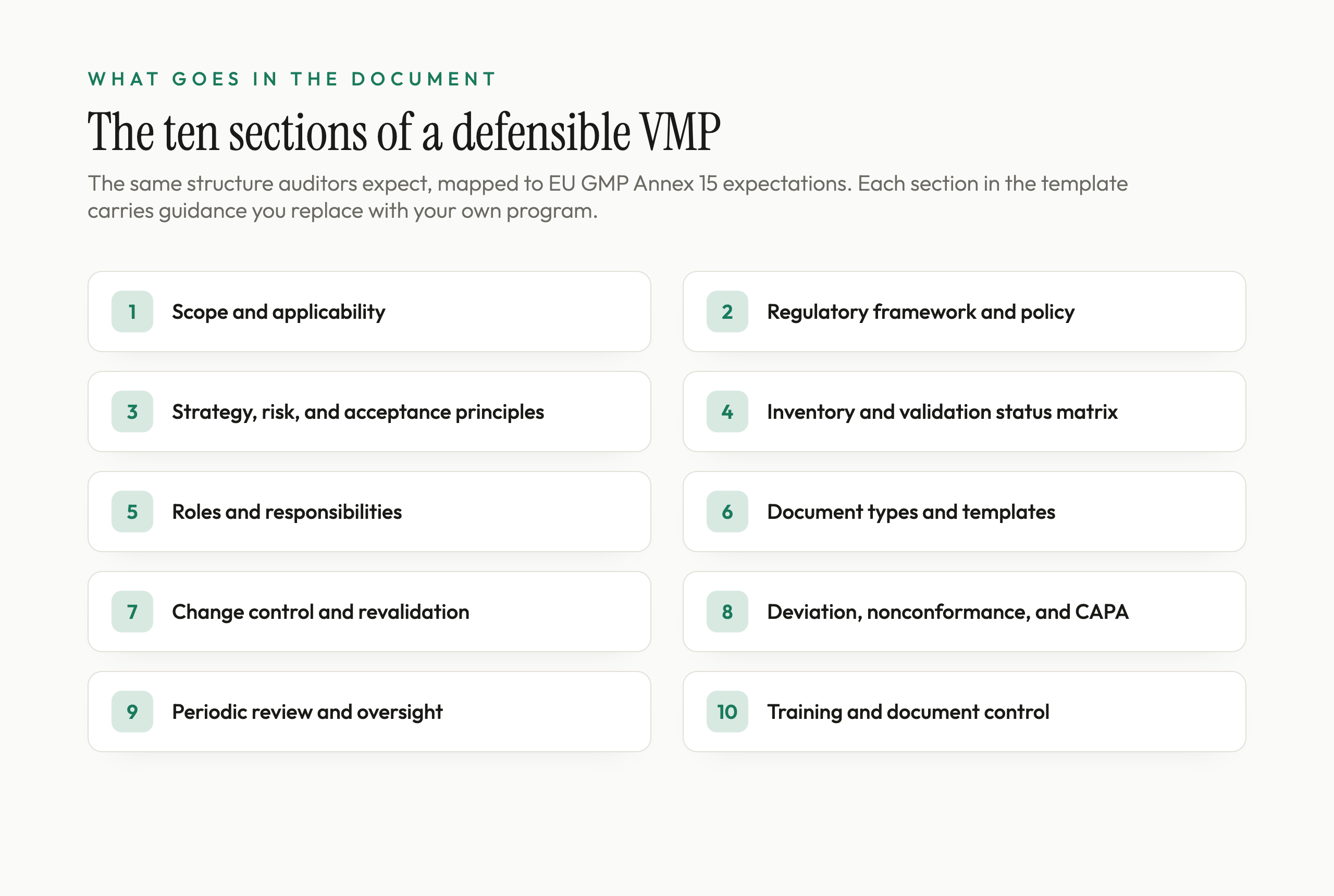
A defensible VMP has a consistent shape regardless of company size or industry. The depth varies; the categories do not. The ten sections below are this guide's working structure for covering the topics EU GMP Annex 15 expects a VMP or equivalent document to address. Annex 15 §1.4 says the key elements of the site qualification and validation programme should be clearly defined and documented in a VMP or equivalent document, and §1.5 lists the information that document should include or reference. The structure here covers those topics without claiming they are the only acceptable section headings.
1. Scope and applicability
State what the VMP covers and, just as important, what it does not. Name the sites, products, processes, and computerized systems governed by this document. Anything out of scope gets a one-sentence reason and a pointer to the document that does cover it. A VMP that does not state its boundaries clearly is the first thing an auditor pulls at. In the template, this is the section to make concrete: list your actual sites and product families rather than leaving the generic line in place.
2. Regulatory framework and validation policy
List the predicate regulations, consensus standards, and guidance documents your validation program is built against, then state your organization's qualification and validation policy in a few sentences. The framework set depends on industry and geography. A US medical device manufacturer anchors to 21 CFR Part 820 under the FDA Quality Management System Regulation, effective February 2, 2026, which incorporates ISO 13485:2016 by reference, with 21 CFR Part 11 as an electronic-records overlay. A pharmaceutical manufacturer anchors to 21 CFR Part 210/211, and to EU GMP Annex 15 and Annex 11 for EU operations. Cite the specific set that governs your activities, not every regulation that exists, and add a sentence on why each applies.
3. Validation strategy, risk approach, and acceptance criteria principles
Describe how you decide what to validate and how much. This is where you state that validation effort is risk-based, name the risk methodology you use, and set out the principles your acceptance criteria follow. You are not writing the criteria for individual protocols here; you are stating the rules those protocols inherit. If you use a software risk framework, this is the place to reference how GAMP 5 categories and the FDA's computer software assurance approach drive computerized-system validation effort.
4. Inventory, validation status matrix, and plan hierarchy
Provide the list of systems, equipment, processes, and facilities in scope, each with its current validation status and a pointer to the governing protocol or plan. This is the section auditors use to navigate your program, so a clear matrix earns goodwill. The template includes a status-matrix table you can populate. Show the hierarchy too: how the VMP sits above individual validation plans, which sit above protocols.
5. Roles and responsibilities
Define who does what across the validation lifecycle: who drafts, who reviews, who approves, who executes, and who owns the VMP itself. Name functions, not individuals, so the document survives staffing changes. State the single accountable owner of the VMP clearly, because a plan with committee-only ownership and no accountable function is the one that drifts. The template provides a responsibilities table keyed to functions.
6. Document types and templates
List the document types your validation program produces, such as DQ, IQ, OQ, PQ, PPQ, CSV, PV, process protocols, reports, and the traceability matrix, and point to the templates each one uses. This section ties the VMP to the rest of your documentation system rather than duplicating it. If you maintain protocol templates centrally, reference them here so the VMP stays the index rather than the library.
7. Change control and revalidation approach
State how changes to validated systems are assessed and how you decide when revalidation is required. You are setting the policy, not running the assessment. Make the triggers explicit: equipment modification, software or firmware update, process change, supplier or material change, and environmental change, plus the role of deviations and trend data. The companion guide on when to redo IQ, OQ, and PQ walks through how those triggers play out in practice.
8. Deviation, nonconformance, and CAPA approach
Describe how validation deviations and nonconformances are handled and how they connect to your CAPA system. The point is to show the inspector that when validation does not go to plan, there is a defined path rather than an ad-hoc scramble. Keep it to how the VMP links to your quality system procedures rather than reproducing them.
9. Periodic review and ongoing oversight
State how often the VMP and the validated state are reviewed, who performs the review, and what triggers an off-cycle review. A VMP is a living document, and the periodic-review section is what proves it is maintained rather than written once and shelved. Set a defined cadence here and name the off-cycle triggers, then hold to it.
10. Training and document control
Close with how personnel are trained on the VMP and the procedures it references, and how the VMP itself is version-controlled, approved, and distributed. This is the section that makes the document auditable as a controlled record: revision history, approval signatures, and effective date. The template's title page and approval block cover the document-control mechanics.
How to fill it in without getting flagged
The fastest way to get a VMP wrong is to fill the template with generic text and issue it. Auditors read a lot of VMPs and recognize boilerplate immediately. Three habits keep your filled-in template defensible.
First, make every section specific to your organization. The scope section should name your actual sites. The inventory should list your real systems. The roles section should map to your real functions. A template that still reads like a template after you fill it in has not been filled in; it has been signed.
Second, keep the VMP as an index, not an encyclopedia. The most common failure is a VMP that tries to contain every procedure and becomes too thick to maintain. The VMP references the procedures that run the day-to-day work; it does not duplicate them. When the underlying procedure changes, a referencing VMP does not need to be rewritten, which is what keeps it a living document.
Third, transition ownership before you issue it. A consultant-drafted or template-drafted VMP is fine as a starting point, but ownership has to land with an internal accountable function from day one. The document the inspector finds should be owned and maintained by your team, with the template treated as the scaffold it was.
How a VMP template fits the regulations
A template is structure; the regulations are why the structure looks the way it does. For medical devices, the QMSR took effect February 2, 2026 and incorporates ISO 13485:2016 by reference, with ISO 13485:2016 §7.5.6 the relevant process-validation clause. A standalone VMP remains an organizational implementation choice for devices, not an explicit FDA line-item requirement, though it is a practical way to document a controlled, risk-based validation program. For medicinal products, EU GMP Annex 15 is explicit: §1.4 expects a VMP or equivalent document, and §1.5 lists the information that document should include or reference. For medicinal-product computerized systems within scope, Annex 11 is the EU GMP anchor, and GAMP 5 and the FDA's computer software assurance guidance are practical risk-based references.
The template covers the structure that satisfies these expectations. The content that makes it defensible is the part only your organization can write.
Where this leaves you
A Validation Master Plan template saves you from a blank page and from forgetting a section your program should address. It does not save you from the work of describing your actual validation program, and it should not. Download the template, walk it section by section, replace every placeholder with what your organization really does, set a real review cadence, and land ownership with an accountable internal function. Done that way, the template becomes a defensible plan rather than a generic file. Done the other way, it becomes the first thing an inspector flags.
If you want the conceptual background behind the structure, read the companion guide on what a Validation Master Plan is and who owns it. For the protocols the VMP governs, the guide to IQ, OQ, and PQ covers what goes in each.
---
Valiqa is an AI-powered validation lifecycle platform for regulated manufacturing. Learn more at valiqa.io
Get new validation guides in your inbox
One or two practical guides a week, written for validation engineers. Unsubscribe anytime. Privacy policy
Frequently Asked Questions
Ready to automate your validation documentation?
Generate audit-ready IQ/OQ/PQ protocols in minutes, not weeks.
Get StartedWe use essential cookies for authentication and security. With your consent, we also use Microsoft Clarity, Google Analytics, and the LinkedIn Insight Tag on our marketing pages to understand how visitors navigate the site and to measure our advertising. Read our privacy policy.