Best Validation Protocol Software for Pharma
There is no single best validation protocol software for pharmaceutical manufacturing, and any vendor who tells you there is has not asked what your team looks like. The honest answer is that there are a few distinct categories of tool, each optimized for a different kind of pharma operation, and the best one for you is the one whose strengths match your team size, your regulatory load, and the adjacent systems you already run.
This guide is category-first on purpose. We walk through the four kinds of validation software a pharma manufacturer will actually encounter, the criteria that matter when the protocol lands in front of an FDA investigator, and where each category fits. We will also be direct about where Valiqa is the right call and where it is not, because a self-serve tool with transparent pricing has no incentive to sell you the wrong tier.
If you want the framework applied to your own team rather than read in the abstract, we built a self-scoring version at /evaluate. It scores your needs across the criteria below and names the category that fits, even when that category is not us.
Looking for validation software built for pharma? See Valiqa's validation software for pharmaceutical manufacturing, with protocols mapped to 21 CFR 210/211 and EU GMP Annex 15.
What "validation protocol software" means in a pharma context
For a pharmaceutical operation, validation protocol software is the tooling that turns regulatory and process requirements into specific, executable protocols and the signed evidence behind them. The relevant predicate regulations are 21 CFR Part 210 and Part 211, the current good manufacturing practice rules for finished pharmaceuticals. Where the protocols involve electronic records and electronic signatures, 21 CFR Part 11 applies on top. Process validation expectations follow current FDA process validation guidance and its lifecycle model of process design, process qualification, and continued process verification.
That scope is broader than equipment qualification alone. A pharma team needs installation, operational, and performance qualification for equipment, computer system validation for its computerized systems, and process performance qualification for the manufacturing process itself. We cover the PPQ stage in depth in the PPQ protocol guide, and the computer-system side in how to write a Part 11 compliant CSV protocol.
The four categories of validation software
The real market is messier than four boxes. You will find hybrid stacks, asset and process management tools that touch validation, and bespoke combinations. But for orientation, four categories capture what each kind of tool optimizes for.
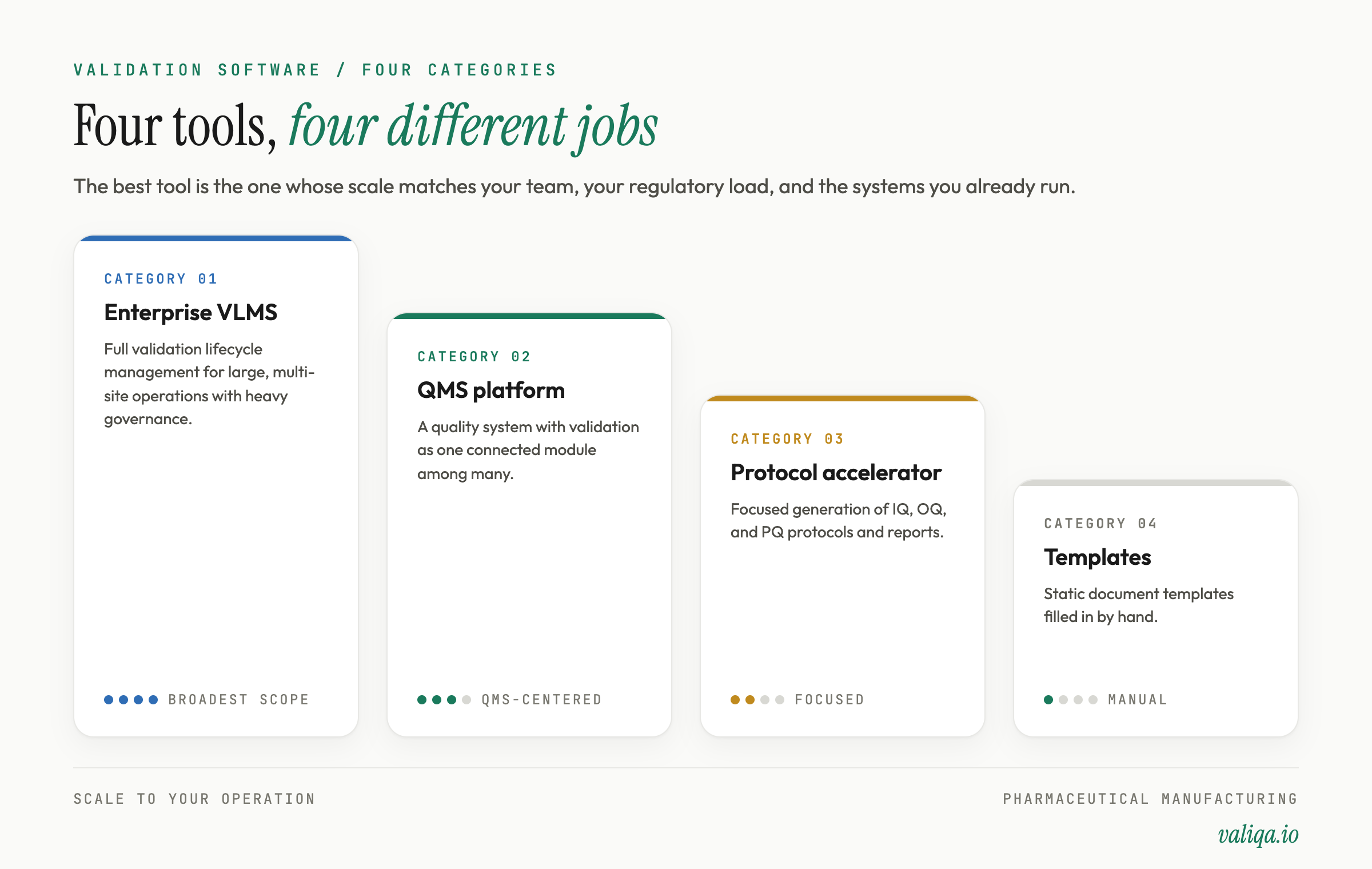
Enterprise validation lifecycle management
These platforms run validation as a coordinated program across many sites and products. They own the full lifecycle: validation master plan, qualification execution, deviation and change control, periodic review, and revalidation, with deep permission models and cross-site reporting.
You buy this when you have a dedicated validation organization, many concurrent qualifications, and regulatory exposure across geographies that has to be governed centrally. The price and the implementation timeline reflect that. Plan for a deployment measured in quarters, not weeks. The trade-off is that authoring a single protocol from a clean equipment context is often slower than writing it by hand, because the system is built around governance, not drafting speed. When this is the category you need, our comparison pages are the honest place to weigh named platforms against each other. And if you are evaluating a move off an enterprise VLMS, our alternative evaluation guide covers what a replacement has to deliver.
Quality management system platforms with a validation module
These broad QMS platforms fold validation in alongside document control, training, supplier management, complaints, and CAPA. The promise is one platform, one audit trail, one bill.
You buy this when consolidating quality processes matters more than depth in any single one, and when validation is one of several functions you need to support. The trade-off is that validation, as one module among many, tends to be shallower. Protocol authoring is usually template-driven with limited automation, and acceptance criteria and regulatory mapping rely on what your engineer types (see how to automate validation documentation for where the automation boundary safely sits). That is fine at a light validation load and becomes a bottleneck as it grows.
Protocol accelerators
These tools focus on the authoring work itself. They take an equipment or process context and produce a complete IQ, OQ, PQ, PPQ, or CSV protocol with test steps, acceptance criteria, and regulatory mapping in a fraction of the hand-authoring time, as a draft your engineer reviews and approves. Some also generate the executed report structure.
You buy this when your bottleneck is authoring speed and consistency, not lifecycle governance. The typical fit is a team with a working QMS already, a focused group of validation engineers, and a backlog of equipment and process qualifications that needs defensible documentation faster. This is the category Valiqa lives in, and we will be specific about its boundaries below. We compare the manual and generated approaches directly in manual protocol vs generated protocol.
Word and Excel templates
The default if you have bought nothing else: a folder of templates, an Excel sheet for test steps, a shared drive, and your engineers' discipline. For a small team with a low qualification load, strong validation literacy, and a few similar equipment types, this works. Many small pharma and contract manufacturers start here. The trade-off is that it does not scale. Templates encode one team's understanding at one point in time, and the gap to regulatory expectations becomes visible as soon as you grow, lose a key engineer, or face more complex equipment.
The criteria that matter for pharma
Once you know the category, compare tools inside it against criteria that show up in FDA findings, not the ones that look good in a demo.
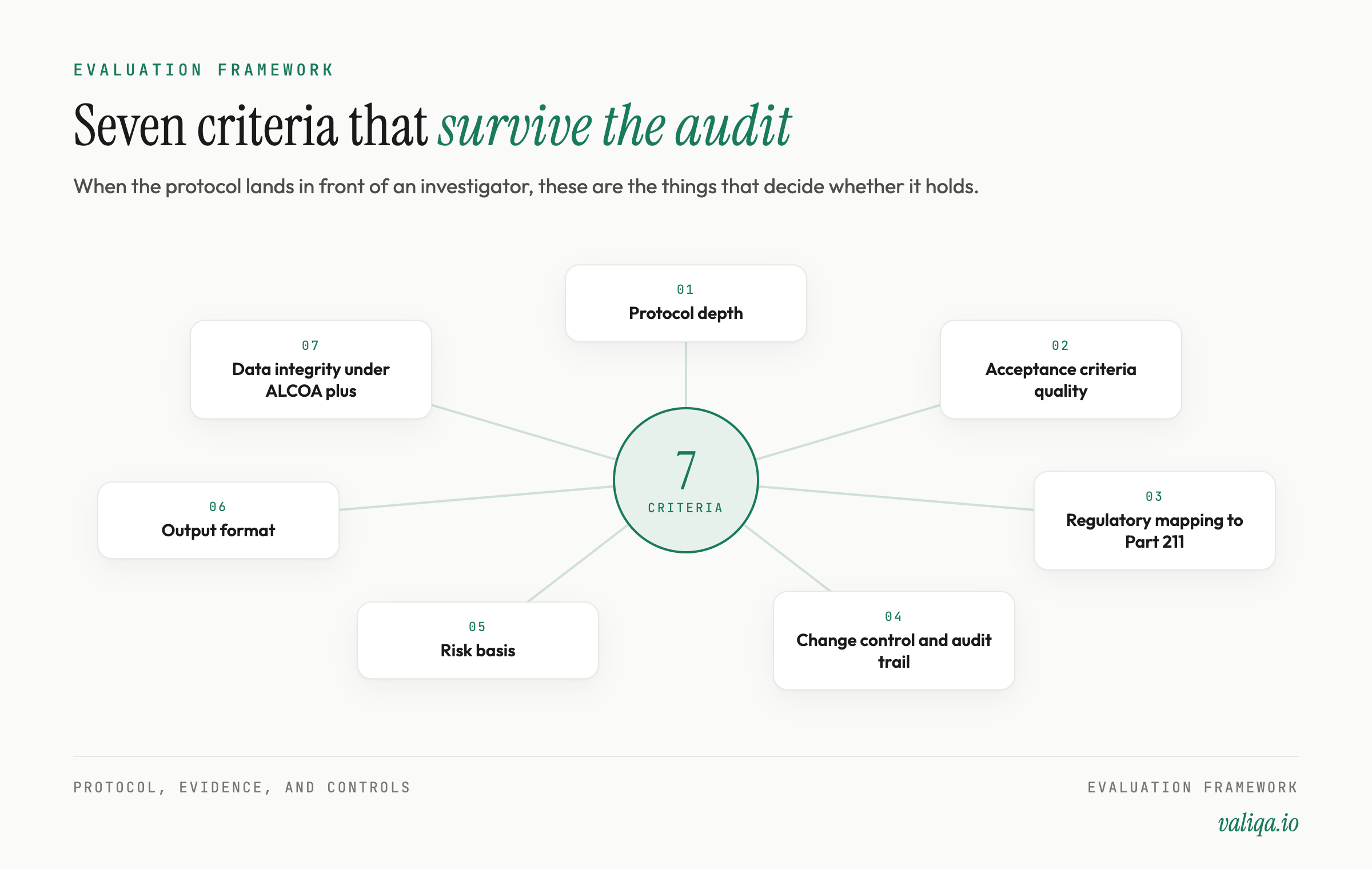
Protocol depth. A protocol should explain what the equipment or process must do, what failure looks like, and why the chosen tests give defensible evidence, not just list generic steps under a cover page.
Acceptance criteria quality. Criteria must be measurable, in real units, tracing to specifications, batch record limits, or design inputs, with a clear pass or fail boundary. The Part 211 predicate rules are the basis for requiring the criterion; the specific value comes from the specification, batch record, or design input, not from the regulation.
Regulatory mapping. For pharma the predicate is Part 210/211, with Part 11 layered where electronic records and signatures apply. ICH Q9 informs the risk approach and GAMP 5 informs computerized-system assurance. A good tool cites the right layer in the right section rather than a generic "complies with applicable regulations" line.
Risk basis. Current FDA process validation expectations and ICH Q9 both frame validation as risk-based. The protocol should scope testing to the risks the equipment or process presents, with a documented rationale, not test everything to the same depth to be safe.
Change control and audit trail. Every change to an approved protocol should be captured with user, timestamp, and a before-and-after record, approved protocols locked except through a controlled revision, and electronic signatures controlled in line with 21 CFR Part 11 where they apply.
Output format and audit readiness. Investigators want a clean PDF or Word file, not a login to your platform. A single-click export to a final, properly formatted document, including the traceability matrix and approval block, matters every single time.
Data integrity. ALCOA+ (attributable, legible, contemporaneous, original, accurate, complete, consistent, enduring, available) governs the records the tool produces. This is non-negotiable in a Part 211 environment and is often the weakest area for tools that added compliance features late.
How the categories tend to score
The table below is Valiqa's evaluative viewpoint on category-level tendencies, based on how each category is designed and positioned, not market data or a benchmark. A specific product can beat or trail its category. Use it as a hypothesis to test in your own trial.
| Criterion | Enterprise VLMS | QMS-centered | Protocol accelerator | Word/Excel |
|---|---|---|---|---|
| Protocol depth | High | Medium | High | Variable |
| Acceptance criteria | High | Medium | High | Engineer-dependent |
| Regulatory mapping | High | Medium | High | Engineer-dependent |
| Risk basis | High | Medium | Medium | Engineer-dependent |
| Change control | High | High | Medium | Low |
| Output format | Medium | Medium | High | Variable |
| Data integrity | High | High | Medium | Low |
No category wins on every criterion. Enterprise platforms lead on governance and lag on authoring speed. Accelerators lead on authoring quality and output but rely on your separate systems for lifecycle governance and long-term records. QMS-centered tools are even but rarely strongest anywhere. Templates rise and fall with your engineers.
Where Valiqa fits for pharma, and where it does not
Valiqa is a protocol accelerator with a self-serve business model. You sign up, enter your equipment or process context, and get a structured IQ, OQ, PQ, PPQ, or CSV protocol draft with measurable acceptance criteria, regulatory mapping, a traceability matrix, and an audit-ready export, all reviewed and approved by your qualified engineer inside your own quality system. Pricing is public at /pricing and you can generate your first protocol without a sales cycle at /signup. The wedge is accessibility: a mid-market pharma or contract manufacturer without a large validation department can be drafting a defensible protocol in minutes rather than negotiating a multi-quarter enterprise contract first. The validation software for pharmaceutical manufacturing page covers how Valiqa maps to 21 CFR 210/211, the FDA process validation stages, and EU GMP Annex 15.
Where Valiqa is the right call: you have a working QMS, a focused set of validation engineers who own approval, and a backlog of qualifications that needs defensible documentation faster without lowering quality.
Where Valiqa is honestly not the right call. Controlled execution itself is no longer the dividing line: Valiqa runs guided step-by-step execution, with per-step witnessed Part 11 e-signatures, a hash-chained audit trail, and deviation management. What still points you to the enterprise category is multi-site execution coordination and an established track record of large-enterprise deployments. Deviations and their CAPAs are handled inside Valiqa - each CAPA links to its deviations and closes under a role-gated, Part 11 e-signed sign-off (Team plans and above). CAPA spanning complaints, suppliers, and change control across the whole quality system is still QMS-centered territory. If you need validated enterprise workflow orchestration across sites and business units, or a vendor-managed long-term record repository, that is enterprise. And if you are running a single qualification a year with one engineer and strong template discipline, you probably do not need a tool yet.
We would rather tell you that at /evaluate than after a contract. A self-serve tool priced in the open only wins when it actually fits.
A short decision path
Start with team size and validation load. A focused validation function gets more from an accelerator or templates than from an enterprise platform. A large organization with concurrent cross-site projects needs the governance the enterprise or QMS-centered categories provide.
Then weigh regulatory load. One geography and one product family suits the lighter categories. Harmonized validation across geographies pushes you toward lifecycle governance.
Then weigh adjacent systems. Buying a QMS in the same window makes the QMS-centered category worth a serious look. A strong existing QMS argues for an accelerator, not a duplicate.
Then weigh growth. Optimize for where your portfolio will be in a year or two, since moving validation tools is expensive.
For the underlying validation work itself, our foundational posts are a good next read: IQ vs OQ vs PQ and what actually goes in each one, the PPQ protocol guide, and how to choose validation software for equipment qualification.
Get new validation guides in your inbox
One or two practical guides a week, written for validation engineers. Unsubscribe anytime. Privacy policy
Frequently Asked Questions
Ready to automate your validation documentation?
Generate audit-ready IQ/OQ/PQ protocols in minutes, not weeks.
Get StartedWe use essential cookies for authentication and security. With your consent, we also use Microsoft Clarity, Google Analytics, and the LinkedIn Insight Tag on our marketing pages to understand how visitors navigate the site and to measure our advertising. Read our privacy policy.