Manual vs Generated Validation Protocols
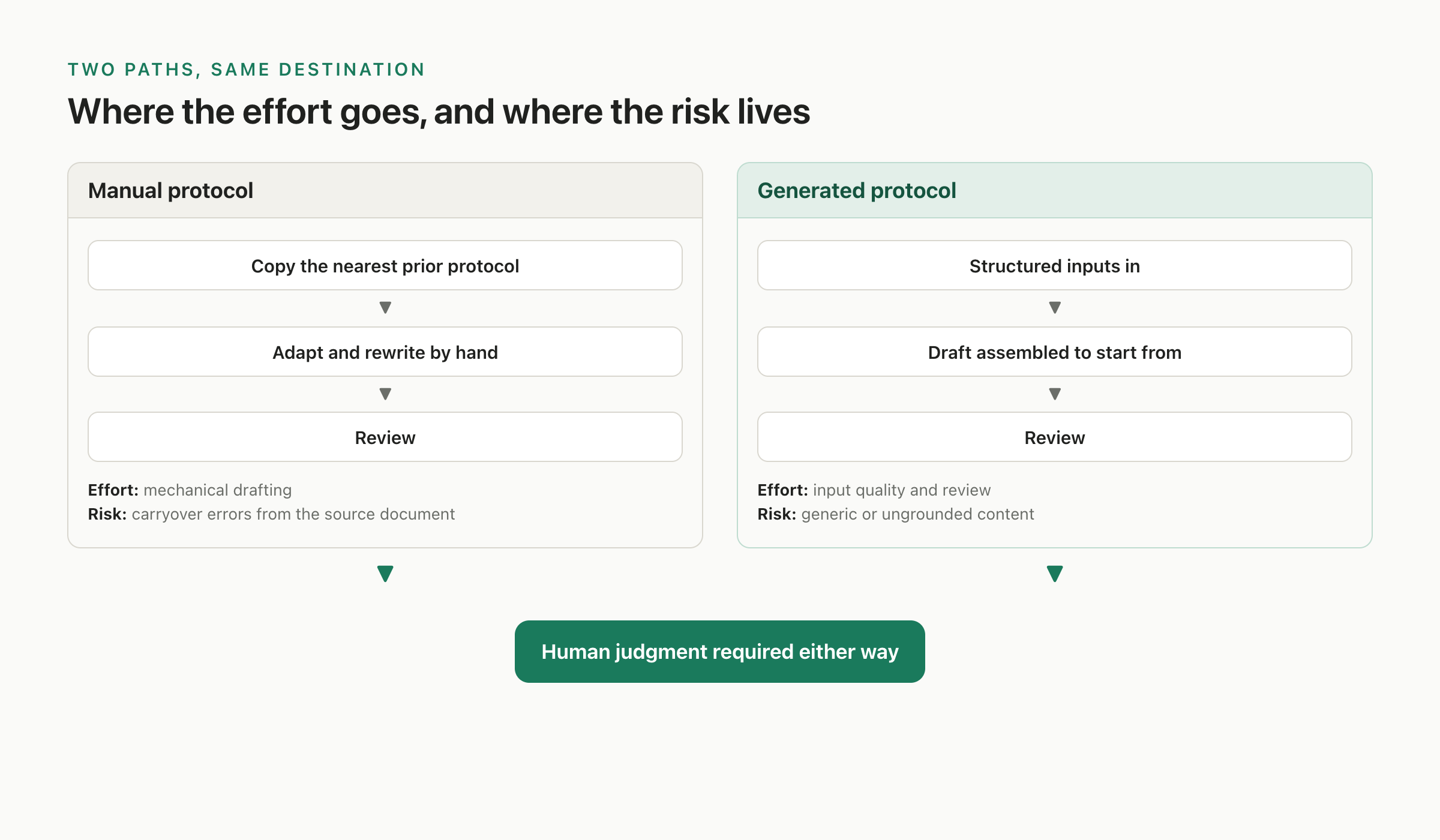
There is a tempting way to frame this comparison that happens to be wrong: manual protocol writing is slow and error-prone, generated protocols are fast and clean, therefore generated wins. The reality is more interesting and more useful. A manual protocol and a generated protocol are not better and worse versions of the same thing. They are two different distributions of where the work goes and where the risk lives. Manual writing puts the effort into mechanical drafting and the risk into copy-paste carryover. Generation puts the effort into input quality and review and the risk into plausible-but-wrong content. Neither removes the engineering judgment that makes a protocol defensible; they relocate everything around it.
This comparison is for the engineer or quality lead deciding how their team should produce IQ, OQ, PQ, and CSV protocols, and who wants a clear-eyed picture rather than a sales pitch. We will walk the two approaches across the dimensions that actually matter in a regulated environment: the starting point, time to a usable draft, consistency, traceability, the characteristic ways each one fails, where reviewer attention has to go, and what no tool and no template can take off the engineer's desk.
What each approach actually is
By manual protocol writing, we mean producing the document by hand in a word processor, typically starting from a blank template or, more often, a copy of the most similar protocol the team wrote before. The engineer adapts the system description, rewrites the test steps, edits the acceptance criteria, updates the regulatory references, and renumbers everything. The knowledge is in the engineer's head and in the prior documents. The tool is a text editor.
By generated protocol, we mean producing a draft from structured inputs: the equipment or system details, the process parameters, the applicable standards, the protocol type, and the company's format conventions, fed into a system that assembles a structured draft with sections, test steps, acceptance criteria, and regulatory mappings already in place. The engineer then reviews, corrects, and completes it. The knowledge is partly encoded in the generator and partly still in the engineer; the tool does the assembly.
The important word in that second definition is draft. A generated protocol is a starting point that a qualified person finishes, not a finished document that a person rubber-stamps. Keep that in mind through every dimension below, because most of the honest trade-offs turn on it.
One scope note before the comparison. For computer system validation, the same manual-versus-generated trade-offs apply, but the documents are scoped by GAMP 5 software categories rather than by equipment qualification logic, so how much of a CSV protocol a generator can safely assemble depends on the category as much as on the inputs. The dimensions below hold for both equipment and software protocols; only the scoping rules underneath them differ.
Dimension by dimension
The starting point. Manual writing almost never starts from a true blank page; it starts from the last similar protocol, which is both the method's strength and its original sin. The prior document carries real, battle-tested content, but it also carries the prior product's specifics, and every one of those is a landmine if it survives into the new document unedited. Generation starts from the current system's structured inputs, so the draft is about this equipment from the first line, but it only knows what the inputs told it, and thin inputs produce a thin or generic draft.
Time to a usable draft. This is the dimension where generation has the clearest edge, and also the one most often overstated. Manual drafting of a full protocol is hours of mechanical work, and we have written before about how long an OQ protocol actually takes. Generation compresses that mechanical drafting, turning the hours of assembling a structured document into a first draft the engineer starts from rather than builds. What it does not compress is the review, the SME input, and the approval routing, which are often the larger share of the calendar time. The honest claim is that generation collapses the drafting phase, not the whole timeline. A team that expects a generated protocol to be ready to execute the moment it appears has misunderstood the tool.
Consistency across a set of protocols. Manual writing makes consistency a discipline problem. Numbering schemes drift, acceptance criteria get phrased five different ways by five engineers, and the regulatory mapping depends on who remembered which clause. Generation makes consistency the default, because the same structure, phrasing patterns, and mappings come out every time. That is a genuine advantage for a team running many protocols, and it is also a risk if the consistent pattern is consistently wrong; an error in a template or a generation pattern propagates cleanly into every document until someone catches it.
Regulatory traceability. A defensible protocol lets an auditor trace a requirement to a specification to a test to an acceptance criterion, the discipline auditors actually look for in validation documentation. Manual writing can achieve excellent traceability, but it depends entirely on the engineer building and maintaining those links by hand, and they are easy to break during edits. Generation can build the scaffolding of that traceability automatically, mapping test cases to the standards and requirements it was given. But it can only map to the requirements it was actually fed, so a generated matrix is only as complete as its inputs, and confirming that completeness is review work, not generation work.
Characteristic failure modes. This is the heart of the comparison. Manual protocols fail by carryover: the previous product's tolerance left in an acceptance criterion, a stale document number, a test step that made sense for the old equipment and not the new, a reference to a standard that no longer applies. These errors are plausible because they are real content, just real content about the wrong thing, which is exactly what makes them hard to spot. Generated protocols fail differently: by generic content that does not fit the specific system, by acceptance criteria that sound right but were not grounded in the actual specification, and by confidently stated test steps that need an SME to confirm they match reality. Both failure modes produce a document that looks finished and is not. The difference is where you have to look to catch them.
Where reviewer attention goes. Because the failure modes differ, the review differs. Reviewing a manual protocol means hunting for carryover: checking every number, tolerance, and reference against the current system, because any of them could be a survivor from the source document. Reviewing a generated protocol means verifying fit and grounding: does each acceptance criterion trace to a real specification, does each test step match how the system actually behaves, is anything generic where it should be specific. Neither review is lighter than the other in principle; they are looking for different things. A team that switches from manual to generated drafting without retraining its reviewers to look for the new failure modes will miss the new errors while no longer needing to hunt the old ones.
What stays human either way
Strip away the tooling and a core of the work is identical across both approaches, because it is engineering and quality judgment that neither a template nor a generator can perform.
Someone has to decide what to validate and how deeply, the risk-based scoping that determines whether a system needs IQ only or full IQ, OQ, and PQ. Someone has to know the process well enough to say which parameters are critical and what the acceptance criteria should actually be, grounded in the specification and the science rather than in a plausible-sounding default. Someone has to run the risk assessment that drives the protocol's priorities. Someone has to execute the protocol, judge the deviations, and sign the conclusion, and whether that execution needs a separate enterprise platform is a question of controls, not categories, which we work through in do AI-generated protocols need an enterprise platform. And someone qualified has to review the draft, whichever way it was produced, and own the result. The FDA has made that enforcement-real: its first warning letter on AI in GMP documentation cites a firm for releasing AI-generated documents without exactly that review.
This is why the framing of "manual versus generated" as a quality contest misses the point. The quality of a protocol comes from the engineering judgment poured into its scope, its criteria, and its review. Generation can remove the hours of mechanical typing and enforce structural consistency, which frees that judgment to spend its time where it matters. It cannot supply the judgment. A generated protocol reviewed carelessly is worse than a manual one written carefully, and a generated protocol reviewed well by someone who understands the system is the same high-quality document, produced with the tedium removed.
So which should a team use
The honest answer depends on volume and on review discipline. A team writing the occasional protocol, with deep familiarity with each system and a strong habit of careful manual review, can produce excellent protocols by hand, and the main cost they pay is time. A team producing protocols at any real volume will struggle to keep manual writing consistent and fast, and stands to gain the most from generation, provided they invest the saved drafting time back into rigorous, retrained review rather than treating the faster draft as a faster finish.
The decision also belongs in the broader question of how a team chooses validation software, because generation is rarely a standalone feature; it sits inside how a tool handles structure, traceability, and your format conventions. Evaluate it the way you would evaluate any control on a regulated process: by what it does to your error modes and your review burden, not by the demo speed.
If your team is drowning in mechanical drafting and your reviewers are strong, generation is the lever that gives you back the most time without lowering the ceiling on quality, which is the case Valiqa is built for: structured inputs in, a structured draft for your engineers to review, and their hours spent on judgment instead of formatting. If your volume is low and your concern is grounding rather than speed, the manual path with disciplined review remains entirely defensible. What no team should do is adopt generation expecting it to remove the review, or stay manual expecting discipline to be free. Both approaches end at the same place: a qualified person who understands the system, owning a document they are willing to defend.
---
Valiqa is an AI-powered validation lifecycle platform for regulated manufacturing. Learn more at valiqa.io
For the boundary between what generation can safely automate and what must stay with your engineer, see how to automate validation documentation.
Get new validation guides in your inbox
One or two practical guides a week, written for validation engineers. Unsubscribe anytime. Privacy policy
Frequently Asked Questions
Ready to automate your validation documentation?
Generate audit-ready IQ/OQ/PQ protocols in minutes, not weeks.
Get StartedWe use essential cookies for authentication and security. With your consent, we also use Microsoft Clarity, Google Analytics, and the LinkedIn Insight Tag on our marketing pages to understand how visitors navigate the site and to measure our advertising. Read our privacy policy.