How to Create Audit-Ready Validation Protocols Quickly
Most teams treat speed and audit-readiness as a trade-off. Go fast and you cut corners that come back as findings. Go slow and careful and you fall behind the equipment backlog. That framing is wrong. The reason validation protocols take so long is almost never the writing itself. It is the rework: the review cycles, the reformatting, the "where did this acceptance criterion come from" back-and-forth, and the audit findings that send a finished protocol back to the start.
An audit-ready protocol produced quickly and a slow protocol that fails an audit are built differently from the first line. This post lays out the workflow that gets you the fast, defensible version, by front-loading the structure that findings usually punish and cutting the rework that actually eats the calendar.
If you want to skip straight to producing one, you can generate a structured IQ, OQ, or PQ protocol from your equipment context and review it against the checklist below. Start at /signup, or read the workflow first.
Where the time actually goes
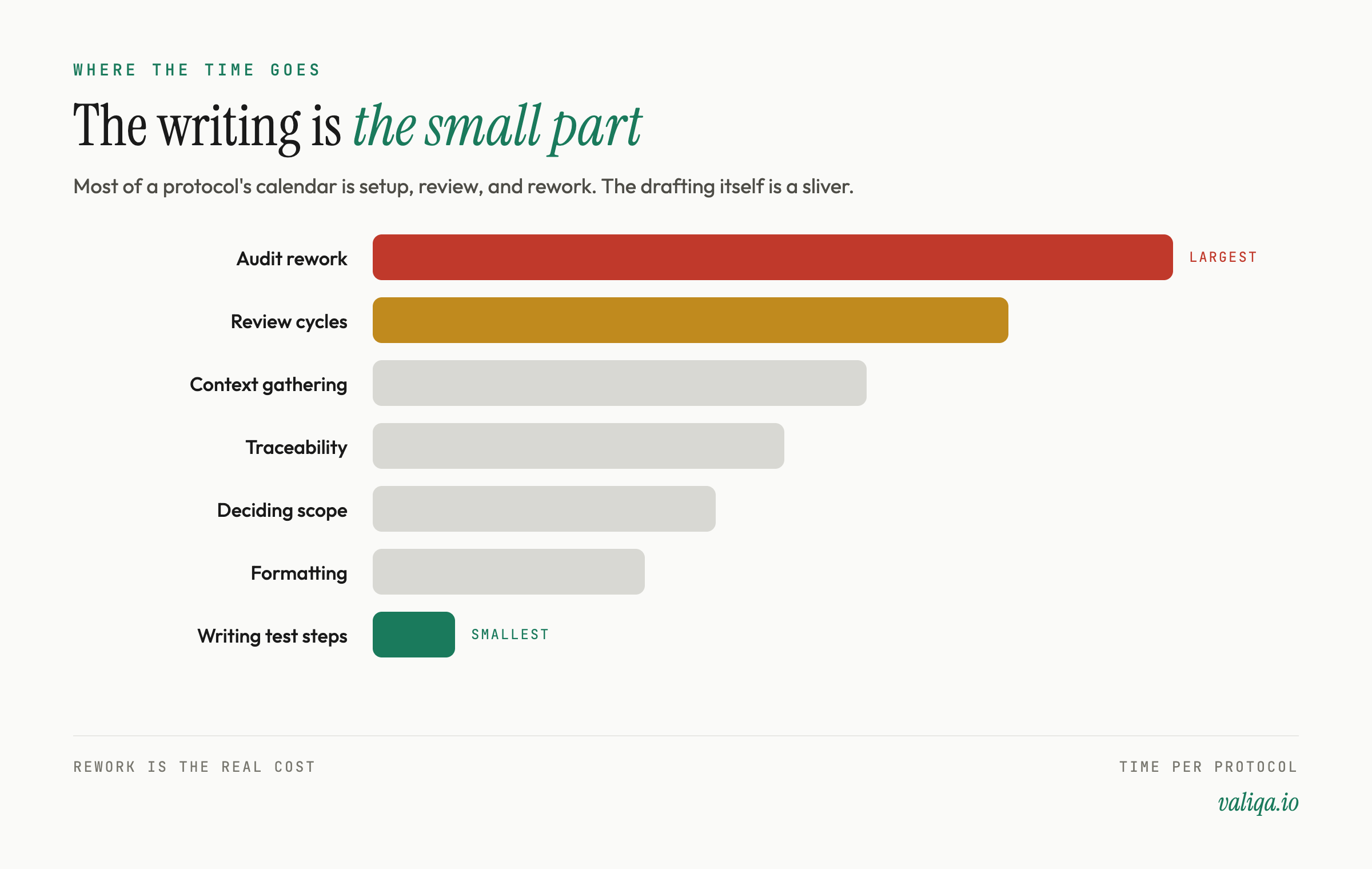
When we broke down how long an OQ protocol really takes in how long does it take to write an OQ protocol, the writing was the small part. The time sinks were upstream and downstream: gathering the equipment context, deciding what to test and why, tracing each test to a requirement, formatting the document to a defensible standard, and then surviving review and any audit rework.
That matters because speed comes from attacking the right stage. Typing faster does nothing. Eliminating a review cycle, or preventing a finding that would have forced a rewrite, saves days. So the goal is not to write faster. It is to get the structure right the first time so the document does not bounce.
The five things auditors check first
Fast and audit-ready meet at a specific set of structural properties. If these five are right before the protocol goes for approval, review is short and audit rework is rare. If any are wrong, you pay for it later at a much higher rate. We cover the reviewer's full view in what auditors actually look for in validation documentation.
- Acceptance criteria that are measurable and sourced. Each criterion states a value, a unit, a limit, and where the limit comes from, so two technicians and one inspector would judge it the same way.
- Traceability from requirement to test to result. Every requirement has a test, every test has a requirement, and the matrix proves it.
- A defensible risk basis. The protocol scopes testing to the risks the equipment presents, with a documented rationale, rather than testing everything to the same depth.
- A correct approval chain. The protocol is approved, with quality assurance among the approvers, before execution, and the completed results are reviewed after.
- A clean, exportable document. The final output is a properly formatted PDF or Word file an inspector can read without you reformatting it.
Getting these five right the first time is the entire game. Everything below is about how to do that without slowing down.
A workflow that is both fast and defensible
Step 1: Capture the equipment context once, completely
Half the rework in validation comes from an incomplete starting picture. The engineer writes the protocol, review finds a missing utility or an unreferenced component, and it goes back. Capture the full context up front: the equipment identity, its intended use, its utilities and environment, the vendor installation and operation manuals, the relevant specifications, and the risk assessment. Complete context in equals fewer review loops out.
Step 2: Let structure be the default, not a decision
The slowest way to write a protocol is to build the skeleton from scratch every time: sections, numbering, approval block, traceability table, deviation handling. That structure is the same across protocols and it is exactly where findings land when it is inconsistent. Start from a structure that is already correct, so your engineer spends time on the equipment-specific judgment, not on rebuilding the frame. Whether that structure comes from a hardened template or a generator, the principle is the same: do not re-decide the frame.
Step 3: Write acceptance criteria against sources, not from memory
The single biggest cause of audit rework is acceptance criteria that read fine but cannot be sourced when an inspector asks. Write each criterion against the specification, the URS, the batch record limit, or the design input it comes from, and name that source in the criterion. This is slower per line and far faster overall, because it is the line that would otherwise trigger a finding. Our full method is in how to write acceptance criteria that won't get flagged in an audit.
Step 4: Build the traceability matrix as you go, not at the end
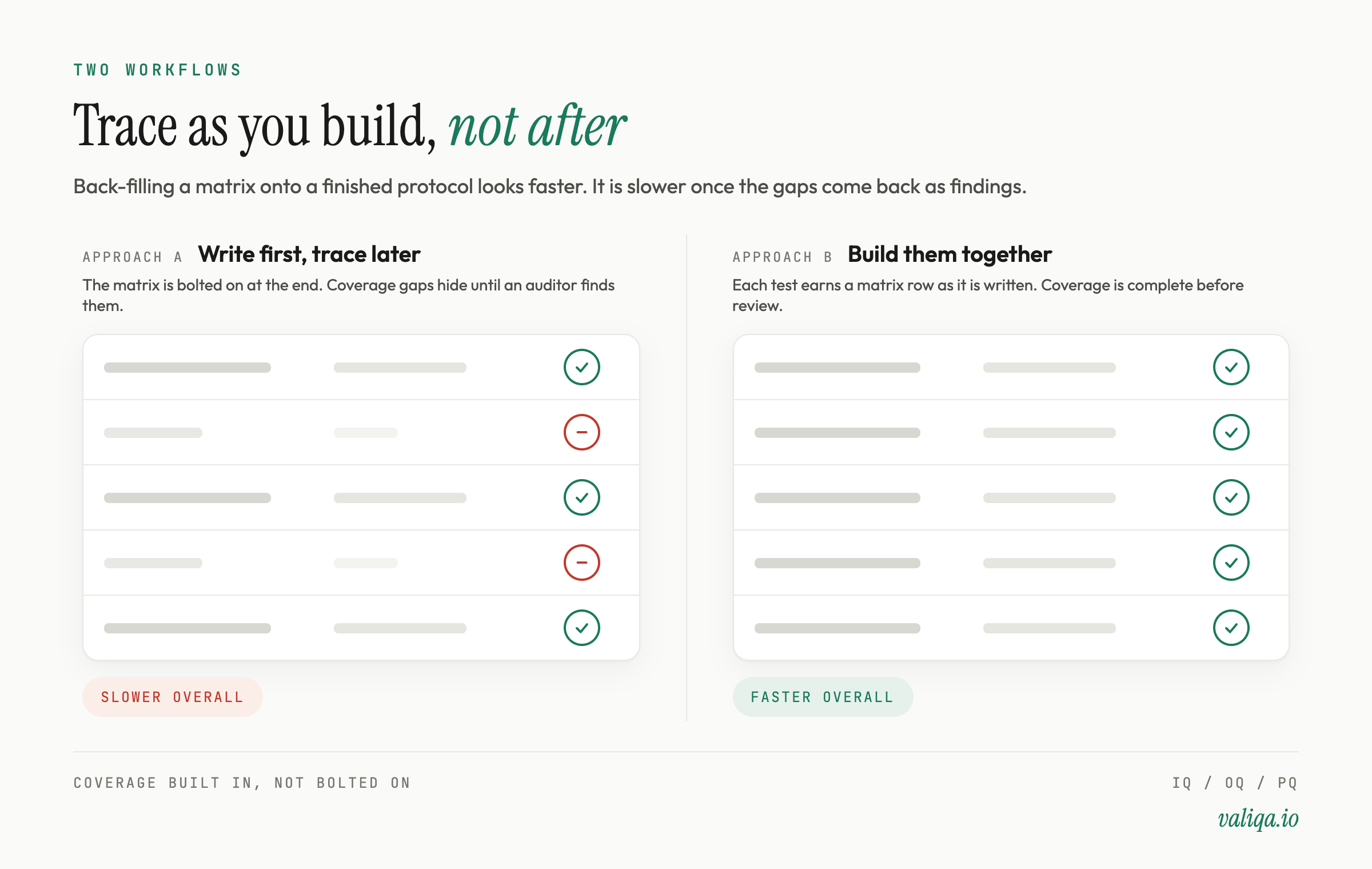
Teams that write the whole protocol and then reverse-engineer a traceability matrix always find gaps, and finding them at the end means rework. Build the matrix alongside the test steps so every requirement gets a test the moment you write it. The matrix becomes a coverage check during authoring instead of a cleanup task after. The full technique is in the traceability matrix in validation.
Step 5: Review against a fixed checklist, not by vibe
Ad hoc review is slow and inconsistent. Review the protocol against the same fixed checklist every time, drawn from the five properties above. A checklist review is faster because the reviewer knows exactly what to look for, and it is more defensible because nothing gets skipped when the reviewer is busy. This is also where a qualified engineer's judgment belongs: on whether the tests are right, not on whether the formatting is consistent.
Step 6: Export the final document once, clean
Reformatting a protocol into an audit-ready PDF by hand is pure waste and a source of last-minute errors. Produce the final document in one export that carries the traceability matrix, the approval block, and the executed evidence sections in a clean layout. Every protocol you produce goes through this step, so the time saved compounds.
Where a generator changes the math
You can run this workflow with hardened Word templates and disciplined engineers, and many good teams do. The reason a protocol generator changes the arithmetic is that it makes steps 2, 4, and 6 free and steps 3 and 5 faster. The structure is correct by construction, the traceability matrix is built with the test steps, and the export is clean and single-click. Your engineer's time moves entirely to the judgment work: is this the right test, is this criterion sourced correctly, does the risk scope hold.
Valiqa is built for exactly this. You enter the equipment context once, and you get a structured IQ, OQ, or PQ protocol draft with measurable acceptance criteria, a built-in traceability matrix, a risk-informed test plan, a correct approval block, and an audit-ready export. It is a draft your qualified engineer reviews and approves inside your own quality system. It does not replace your engineer or sign the protocol. It removes the rework that makes protocols slow, so fast and audit-ready stop being a trade-off. The business model is self-serve with transparent pricing, so a mid-market team without a validation department can be producing a defensible protocol in minutes: see /pricing, start at /signup, or begin from your equipment type with the protocol selector.
If you are not sure a generator is even the right category for your team, run your team through the evaluator at /evaluate. For a light load with one engineer and strong template discipline, a checklist and a good template may be all you need, and we will say so.
Get new validation guides in your inbox
One or two practical guides a week, written for validation engineers. Unsubscribe anytime. Privacy policy
Frequently Asked Questions
Ready to automate your validation documentation?
Generate audit-ready IQ/OQ/PQ protocols in minutes, not weeks.
Get StartedWe use essential cookies for authentication and security. With your consent, we also use Microsoft Clarity, Google Analytics, and the LinkedIn Insight Tag on our marketing pages to understand how visitors navigate the site and to measure our advertising. Read our privacy policy.