Regulatory Traceability in IQ OQ PQ Protocols
A set of IQ, OQ, and PQ protocols without traceability is a stack of test steps that happens to be true. A set with traceability is a defensible argument that every requirement was verified, every test earns its place, and every acceptance criterion is grounded in a real source and a real regulation. The difference is the entire distance between passing an audit and failing one.
This post is about building that traceability into IQ, OQ, and PQ protocols on purpose. It covers what regulatory traceability actually connects, how to trace forward from user requirements through risk controls to test steps and evidence, how to trace backward so nothing is orphaned, and how the predicate regulation anchors each link so an inspector's hardest question has a fast answer.
If you want to see a traceability matrix built into a live protocol rather than described, you can generate a structured IQ, OQ, or PQ protocol from your equipment context and inspect the matrix it produces. Start at /signup, or read the model first.
What regulatory traceability actually connects
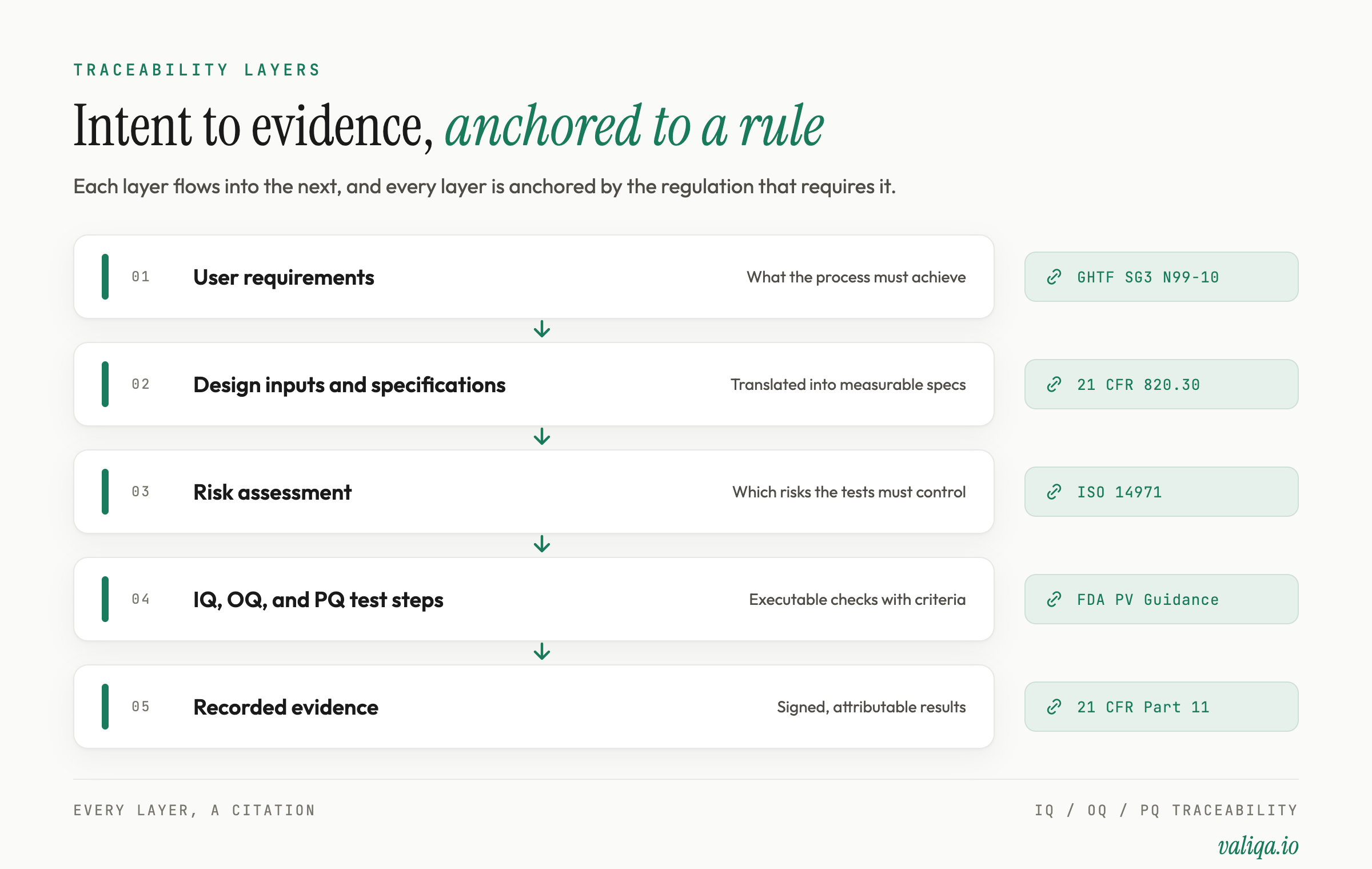
Traceability in validation is not one link. It is a chain that runs from intent to evidence to regulation, and a defensible protocol makes every link explicit.
The chain starts at the user requirements specification, the URS, which states what the equipment or process must do for its intended use. From there it runs to the design inputs and equipment specifications that define how those requirements are met. From there to the risk assessment, which identifies where failure to meet a requirement would matter and what controls mitigate it. From there to the specific IQ, OQ, or PQ test step that verifies the requirement or control. From there to the recorded evidence that the test passed. And underneath every link sits the regulatory basis: the predicate regulation, the consensus standard, and the guidance that make the whole structure something a regulator recognizes.
Regulatory traceability means all of that is connected and visible, not implied. We cover the mechanics of building the matrix itself in the traceability matrix in validation; this post is about what it connects and why the regulation belongs in it.
What each stage traces, specifically
The three qualification stages verify different things, so they trace to different sources. Mixing them up is a common cause of findings, and we cover the boundary in IQ vs OQ vs PQ and what actually goes in each one.
IQ traces installation requirements, drawn from the URS, the design specification, and the vendor installation manual, to the test steps that verify the equipment was installed in conformance with its approved design. The regulatory anchor is the predicate regulation's requirement that equipment be suitable for its intended use and properly installed.
OQ traces operational requirements, the intended operating ranges and functions, to the test steps that verify the equipment operates correctly across those ranges. The acceptance criteria trace to the equipment specifications and design inputs, with the predicate regulation cited as the basis.
PQ traces performance requirements, consistent performance under real production conditions, to the test steps and sampling that demonstrate it. This is where process validation expectations, current FDA process validation guidance and the GHTF process validation guidance GHTF/SG3/N99-10:2004, most directly anchor the qualification.
The three regulatory layers, and why to distinguish them
A frequent audit weakness is a protocol that gestures at "applicable regulations" without distinguishing the layers. Regulators expect you to know which is which, because they carry different weight.
The predicate regulation. This is the enforceable rule. For a US medical device manufacturer, the predicate is the FDA Quality Management System Regulation in 21 CFR Part 820, which under the QMSR final rule incorporates ISO 13485:2016 by reference. For a US pharmaceutical operation, the predicate is 21 CFR Part 210/211. Where electronic records and signatures are involved, 21 CFR Part 11 applies on top, regardless of industry. The predicate regulation is what an inspector enforces.
Consensus standards. ISO 13485 as a standard, ISO 14971 for risk management. These define recognized practice. They are how the predicate rule is met, not the rule itself.
Industry guidance. GAMP 5 for computerized systems, GHTF and IMDRF documents for medical device process validation, ICH Q9 for risk management, current FDA process validation guidance. Guidance shows how regulators expect the predicate rule to be interpreted. It is not enforceable on its own, but ignoring it invites questions.
Good regulatory traceability cites the right layer in the right place. The acceptance criterion traces to a specification with the predicate regulation as its basis. The risk section references the risk-management standard and guidance. The electronic-signature controls cite Part 11 where they apply. We use "expectations" deliberately where the regulation does not literally prescribe a step, because overclaiming what a regulation requires is its own kind of finding.
Forward and backward tracing
Traceability has to work in both directions, and each direction catches a different failure.
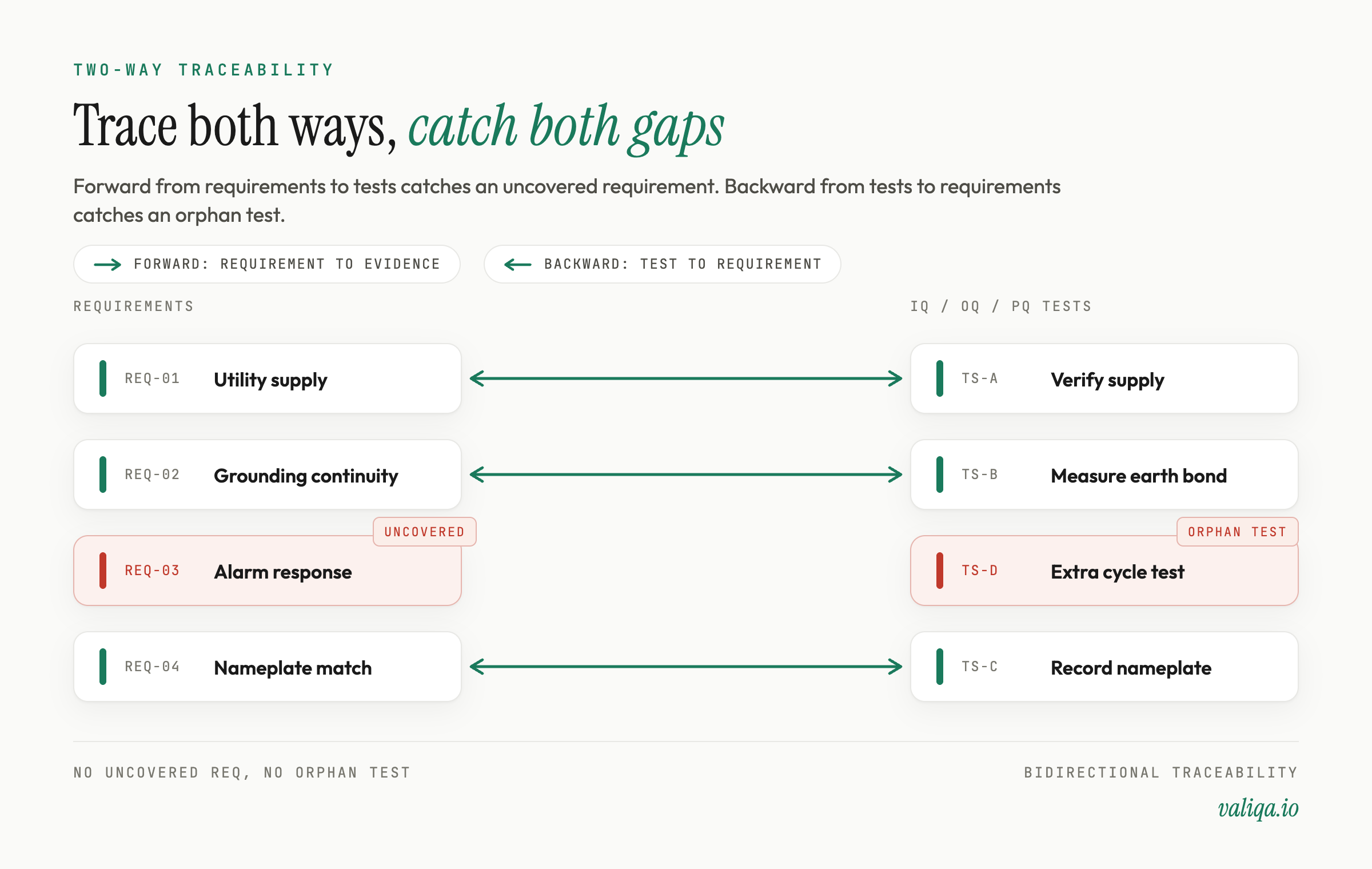
Forward tracing starts at a requirement and follows it to its test and evidence. It answers "was this requirement verified?" Forward gaps are uncovered requirements: something the equipment must do that no test checks. An inspector who finds one has found a hole in your qualification.
Backward tracing starts at a test step and follows it back to the requirement it verifies. It answers "why is this test here?" Backward gaps are orphan tests: steps that verify nothing traceable, which either waste execution time or, worse, suggest the protocol was assembled without a clear rationale. An orphan test invites the question of what else in the document is boilerplate.
A complete traceability matrix closes both directions. Every requirement reaches a test and evidence. Every test reaches a requirement. When that holds, the inspector's hardest question, "show me where this requirement was verified," and its mirror, "why did you run this test," both have instant answers.
Building traceability in, not bolting it on
The expensive way to get traceability is to write all three protocols, execute them, and then reverse-engineer a matrix for the audit. That always surfaces gaps, and surfacing them at the end means rework at the worst time.
The cheaper way is to build the matrix as you author. When you write a requirement, you attach its test. When you write a test, you attach its requirement and its regulatory basis. The matrix becomes a live coverage check instead of a cleanup task, and the regulatory anchor is captured while you are already thinking about that requirement, not reconstructed later from memory.
This is where a protocol generator earns its place. It can build the traceability matrix alongside the IQ, OQ, and PQ test steps automatically, pull the right predicate regulation and standard into each section as scaffolding, and produce the matrix as part of the audit-ready export, all as a draft your qualified engineer reviews and approves. The engineer's time goes to confirming the traces are correct and the risk scope holds, not to constructing tables.
Valiqa is built for exactly this. You enter the equipment context, and you get structured IQ, OQ, and PQ protocol drafts with measurable acceptance criteria, a built-in requirements-to-tests-to-evidence traceability matrix, regulatory mapping to the right predicate and standard, and an audit-ready export. It is a draft your qualified engineer reviews and approves inside your own quality system. It does not replace the engineer or own the regulatory judgment. The self-serve model with transparent pricing means a mid-market team without a validation department can produce a fully traced protocol package in minutes: see /pricing, start at /signup, or begin from your equipment type with the protocol selector.
If you want to know whether a generator fits your team or whether a hardened template and a disciplined matrix habit would serve you better, the self-scoring evaluator at /evaluate gives you a straight answer either way.
Get new validation guides in your inbox
One or two practical guides a week, written for validation engineers. Unsubscribe anytime. Privacy policy
Frequently Asked Questions
Ready to automate your validation documentation?
Generate audit-ready IQ/OQ/PQ protocols in minutes, not weeks.
Get StartedWe use essential cookies for authentication and security. With your consent, we also use Microsoft Clarity, Google Analytics, and the LinkedIn Insight Tag on our marketing pages to understand how visitors navigate the site and to measure our advertising. Read our privacy policy.